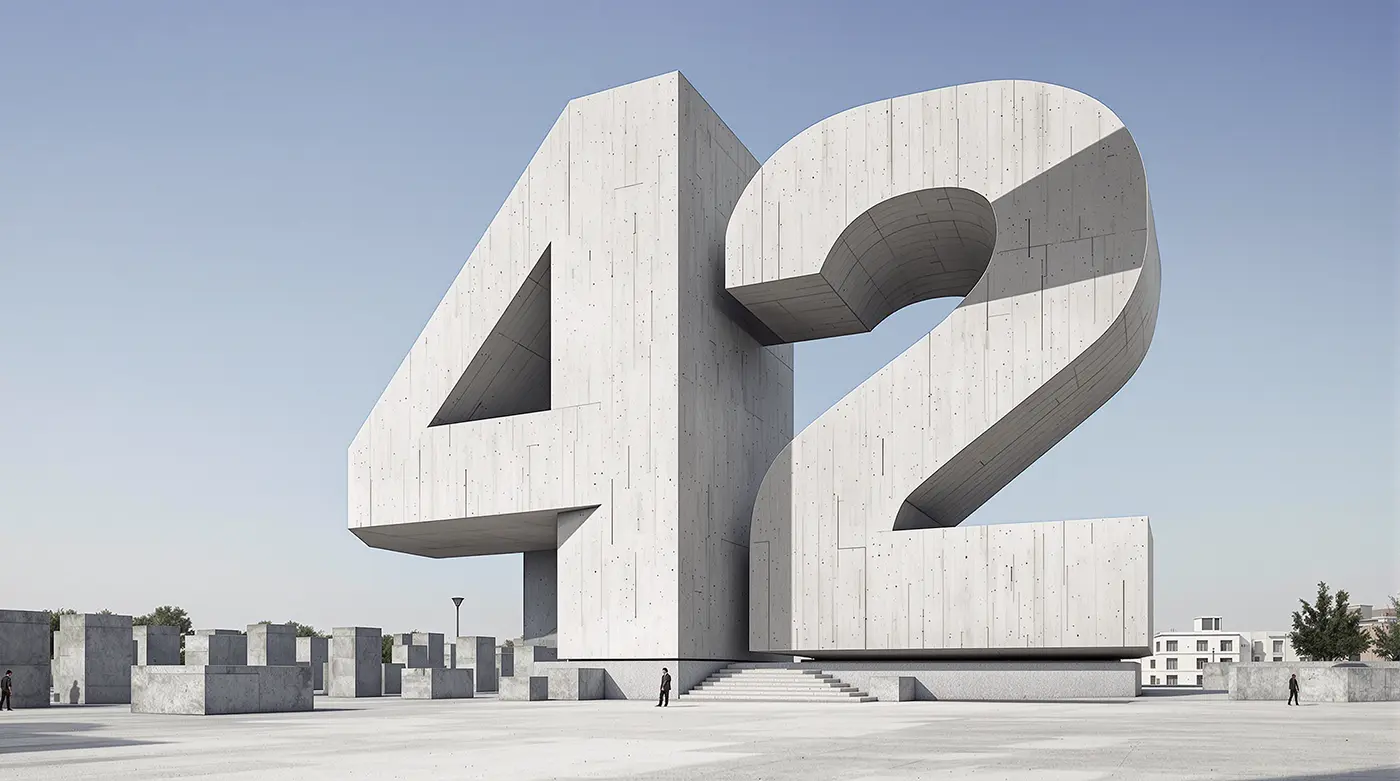
The Surprising Significance of 42: Beyond the Hitchhiker's Guide
When Douglas Adams wrote that the "Answer to the Ultimate Question of Life, the Universe, and Everything" was 42 in his science fiction masterpiece "The Hitchhiker's Guide to the Galaxy," readers around the world chuckled at what seemed like a perfectly random number chosen for comedic effect. The joke works brilliantly because it subverts our expectations—after millions of years of computation, the supercomputer Deep Thought delivers not a profound philosophical statement but a seemingly arbitrary number.
But was 42 truly random? As with many elements of Adams' work, what appears as whimsy on the surface often conceals deeper currents of meaning. The number 42 carries a rich tapestry of mathematical, cultural, and historical significance that may have influenced—consciously or unconsciously—Adams' famous selection. Let's embark on a journey to understand why 42 might be more meaningful than it first appears.
The Mathematical Marvel of 42
Numbers are rarely just numbers. They carry properties and relationships that mathematicians have explored for millennia. The number 42 stands out in several intriguing ways:
A Perfect Sum
42 is the sum of the first six positive even numbers: 2 + 4 + 6 + 8 + 10 + 12 = 42. This gives it a certain mathematical elegance and completeness.
When examining its factors, we find that 42 has eight distinct factors: 1, 2, 3, 6, 7, 14, 21, and 42 itself. Its prime factorization is 2 × 3 × 7, meaning it can be expressed as the product of three distinct prime numbers—a property that resonates in numerous mathematical contexts.
The factor pairs of 42, (1, 42), (2, 21), (3, 14), and (6, 7), showcase a balanced symmetry. Even more fascinating, 42 appears in the realm of higher mathematics: in 2019, mathematicians finally found a solution to the centuries-old problem of representing 42 as the sum of three cubes, demonstrating an unexpected bridge between elementary arithmetic and advanced number theory.
(For example, one such solution is: (-80538738812075974)³ + (80435758145817515)³ + (12602123297335631)³ = 42)
The Connection to the Primes
In mathematics, prime numbers serve as the building blocks of all other numbers. They're fundamental to number theory, and 42 has a special relationship with them. 42 is the product of the first three prime numbers that form a complete set when multiplied: 2 × 3 × 7 = 42.
This relationship to prime numbers gives 42 a certain foundational quality—it's built from the atomic elements of mathematics in a neat, ordered way.
The Jackie Robinson Connection
Baseball fans might recognize 42 as Jackie Robinson's jersey number, which has been retired across all Major League Baseball teams—the only number to receive this honor. Robinson broke baseball's color barrier in 1947, making 42 a symbol of social progress and equality.
42 in Science and the Natural World
Beyond pure mathematics, the number 42 appears in surprising places throughout science and nature:
Degrees of Angle
The rainbow appears at precisely 42 degrees. Light refracts inside raindrops at this specific angle, creating the colorful arc we see in the sky. This means that when you see a rainbow, you're observing light being bent at exactly 42 degrees—a literal connection between this number and one of nature's most beautiful phenomena.
The Critical Angle
In physics, 42 degrees is approximately the critical angle of water. When light passes from water to air, it completely reflects rather than refracts if it hits the surface at an angle greater than 42 degrees. This is why, when underwater, you see a perfect mirror of the world above when you look up at a sufficiently low angle.
DNA and Life Itself
The angle of the DNA double helix is approximately 42 degrees, meaning that the very blueprint of life itself twists at this particular angle. If we're searching for the meaning of life in the number 42, perhaps we need look no further than our own genetic code.
42 in Technology and Computing
The significance of 42 extends deeply into the realm of technology, where it plays a surprisingly central role in how computers process information.
The Asterisk Connection
Perhaps the most fascinating technical aspect of 42 is that it represents the ASCII code for the asterisk (*) character in computing. This is far more than a trivial coincidence. The asterisk serves as a wildcard character in programming languages, database queries, and search functions, representing "anything" or "everything" when performing pattern matching. This creates a stunning parallel between the technical implementation and Adams' fictional concept—the number representing "the answer to everything" in the novel actually represents the wildcard symbol for "everything" in computer systems.
When programmers use an asterisk in their code to match any possible value, they are unwittingly invoking the number 42. This technical connection adds another layer to the number's multifaceted significance—bridging fiction and practical computing in an almost poetic way.
42 in Technical Standards
Beyond the asterisk connection, 42 appears in numerous technical specifications. In the TIFF (Tag Image File Format) specification, the second 16-bit word of every TIFF file is precisely 42—deliberately chosen as a file signature. In the reiser4 file system, 42 is designated as the inode number of the root directory. Even Microsoft Windows has a connection—its default password expiration policy is set to 42 days.
Perhaps most deliberately referential is the military IRIG 106 Chapter 10 data recording standard, which uses the hexadecimal value 0x464F52545974776F (translating to ASCII "FORTYtwo") as a magic number to identify directory blocks. These technical implementations show how 42's cultural significance has influenced even formal engineering standards.
The 42 Programming School
The technical significance of 42 has even extended into education through the innovative "42" programming school. This institution has developed a unique approach to software engineering education based on peer-to-peer learning without traditional teachers. The school offers a gamified curriculum divided into phases, emphasizing practical, project-based learning where students progress through increasingly difficult challenges.
This educational model has gained international recognition for producing adaptable, self-directed software engineers prepared for the constantly evolving technology landscape. The choice of "42" for this revolutionary educational approach further cements the number's association with comprehensive answers and innovative thinking.
The Musical Life of 42
The number 42 has established a surprisingly significant presence in the world of music and sound, from band names to audio equipment and even therapeutic frequencies.
Level 42: The Pioneering Jazz-Funk Band
Perhaps the most prominent musical embodiment of 42 comes in the form of Level 42, an English jazz-funk band formed on the Isle of Wight in 1979. This ensemble carved out a significant place in music history with numerous hits throughout the 1980s and 1990s. Their commercial breakthrough came with singles like "Lessons in Love," which climbed to number three on the UK Singles Chart, and "Something About You," which reached number seven on the US Billboard Hot 100.
After disbanding in 1994 following personnel changes and shifting musical directions, Level 42 reformed in 2001 and continues to perform, representing one of the most recognizable musical entities bearing this numerical identity.
Audio Technology and the 42 Hz Frequency
In the realm of musical instruments, the Solar 42 synthesizer—created by a Ukrainian inventor—represents a specialized approach to sound creation. Specifically designed for producing ambient drone music, this instrument features computer key buttons that activate different drone voices and a distinctive design that resembles "the controls of a spaceship." By focusing exclusively on drone and ambient sound generation, this instrument embodies a philosophical approach to sound that values sustained, atmospheric textures.
Beyond conventional music, the specific frequency of 42 Hertz has garnered attention for its purported therapeutic properties. Some researchers suggest that exposure to this low-frequency sound may help promote relaxation and reduce stress levels by resonating with the human body's natural rhythms. Practitioners have begun incorporating this specific frequency in sound therapy and music therapy sessions, suggesting it may help alleviate symptoms associated with anxiety and depression.
Even audio equipment manufacturers have embraced the number, with products like the MyST Gatling 42 headphones and Micca RB42 Reference Bookshelf Speakers incorporating 42 into their model designations. Various musical artists have also released songs titled "42," including Mumford and Sons, Coldplay, and French-Malian artist Aya Nakamura, further cementing the number's presence in musical culture.
Cultural and Historical Significance of 42
Numbers often carry cultural weight, appearing in mythology, religion, and literature long before Adams penned his cosmic joke:
The 42 Puzzle
Intriguingly, in 1994, Adams created "The 42 Puzzle"—an illustration featuring 42 multi-colored balls arranged in 7 columns and 6 rows. This puzzle was explicitly designed with multiple solutions, featuring the number 42 in ten different ways, including through the total count of spheres (6×7=42), binary representations, and Roman numerals formed by certain colored spheres.
Adams noted with irony that while readers had spent years looking for hidden puzzles in his work, when he actually created one, it received little attention. This meta-commentary on fan theories represents Adams's playful acknowledgment of how his arbitrary choice had taken on a life of its own in cultural discourse.
Ancient Egyptian Connection
In Ancient Egyptian mythology, 42 was deeply significant. The 42 Principles of Ma'at were the moral ideals that guided the judgment of the dead. When a person died, their heart was weighed against the feather of Ma'at (truth and justice), and they had to make 42 "negative confessions" declaring the evils they had not committed during their lifetime.
This connects 42 directly to the ultimate judgment of a human life—a literal "answer" about the value and meaning of one's existence.
Biblical and Religious Dimensions of 42
The number 42 appears with striking frequency in biblical texts. In the King James Bible, the phrases "forty and two" and "two and forty" occur 14 times across 14 verses, with particular concentration in the books of Nehemiah, Ezra, and 2 Kings.
In the Book of Revelation, 42 months is specifically mentioned as the duration of the Antichrist's authority during the end times. According to Revelation 11:1-2, this is the period when "they shall trample upon the holy city," and in Revelation 13:4-5, it's described as the timeframe during which the Beast power will have authority.
From a genealogical perspective, 42 represents significant lineages in biblical history. The Gospel of Matthew traces 42 generations from Abraham to Jesus Christ, while the Gospel of Luke similarly references 42 generations from David to Christ. These parallel genealogies connect the number to the fulfillment of messianic prophecy and divine plan through human lineage.
Biblical scholars note that 42 can be symbolically derived as 6×7, which carries deep meaning. In biblical numerology, 6 is associated with mankind (created on the sixth day), while 7 represents divine perfection or completeness. The product of these numbers creates a connection between human existence and divine will.
In Hebrew, 42 is written as Mem Bet (מב), which carries additional symbolic significance. Some interpretations suggest that "בם is also an allusion to the Written and the Oral Torah. The ב represents the Written Torah which begins with a ב. The מ represents the Oral Torah which begins with a מ." This connection to foundational religious texts adds another layer of meaning to the number in Jewish mystical traditions.
Other biblical connections include the tribe of Levi receiving 42 cities, King Ahaziah of Judah beginning his reign at age 42, the children who mocked the prophet Elisha being attacked by 42 bears, and the phrase "little children" appearing exactly 42 times in the Old Testament.
These appearances in sacred texts lend 42 a mystical quality that transcends mere numerology.
Numerological and Esoteric Dimensions
Beyond mathematics and literature, numerology offers another perspective on 42. In numerological traditions, numbers carry vibrational energy and symbolic meaning that influence various aspects of life and consciousness.
In numerology, 42 is a compound number that combines the energies of its constituent digits. The number 4 symbolizes practicality, organization, and stability, while 2 represents balance, harmony, and cooperation. Together, they create an energy that numerologists associate with building stable foundations for family and community. The number 42 is often interpreted as representing a practical approach to nurturing relationships and creating harmony within one's immediate environment.
Numerological interpretations describe 42 as a "dynamic and responsible force" that drives individuals to care for others and establish stable environments. People associated with this number in numerological analyses are believed to possess a pragmatic idealism—they not only envision better circumstances for their communities but also have the practical skills to work toward those ideals. This blend of visionary thinking and practical application makes 42 a number associated with balanced leadership and community building.
In angel number traditions, which interpret recurring numbers as messages from spiritual entities, 42 is regarded as a powerful sign. When this number appears repeatedly in someone's life, it's interpreted as a message encouraging balance between practical matters and spiritual growth. The spiritual significance of 42 extends across various cultures and belief systems, where it often represents a connection between the material and divine realms.
Numerologically, 42 also reduces to 6 (4 + 2 = 6), a number associated with harmony, balance, and nurturing. The number 6 is connected to domestic affairs, responsibility, and service to others. This suggests that within the cosmic joke of 42 lies a deeper truth about the importance of balance and care in finding meaning.
The Chinese Connection
In Chinese culture, the number 42 has special significance because when spoken in Mandarin, it sounds similar to the phrase "easy death" or "it is easy to die." This has made 42 somewhat taboo in certain contexts, highlighting how even the sound of a number can carry meaning across cultural boundaries.
Douglas Adams and 42
With all this context, we can return to Adams and his famous selection of 42. While Adams himself claimed he chose the number arbitrarily, saying "It was a joke. It had to be a number, an ordinary, smallish number, and I chose that one," there are several theories about potential inspirations:
Lewis Carroll's Influence
Adams was known to be a fan of Lewis Carroll, author of "Alice's Adventures in Wonderland." In Carroll's work "The Hunting of the Snark," the Baker had "forty-two boxes, all carefully packed." This parallel to another British author's seemingly random use of 42 might have influenced Adams.
A Programmer's In-Joke
As a technologically savvy writer, Adams might have been aware that in ASCII code (a system used by computers to represent text), the asterisk symbol (*) is represented by the decimal number 42. In computing, the asterisk is often used as a wildcard or to represent "anything" or "everything"—making it a perfect symbol for the answer to the ultimate question of life, the universe, and everything.
This connection is particularly compelling because it suggests that perhaps the answer to life's ultimate questions is not a specific solution but rather a wildcard—an open-ended possibility that encompasses all potential answers. The asterisk's function as a placeholder for unlimited possibilities mirrors philosophical perspectives suggesting that meaning is not fixed but individually constructed and infinitely variable.
A fascinating linguistic connection adds another layer: the alphanumerical sum of the phrase "To Be" equals 42. When assigning numeric values to letters based on their position in the alphabet (T=20, O=15, B=2, E=5), the sum is exactly 42. This links the number to perhaps the most fundamental philosophical question of existence itself—Shakespeare's famous "To be or not to be"—creating yet another dimension to its significance.
The Connection to Base 13
Adams once joked that he wouldn't "do jokes in base 13 for anybody." Interestingly, if you calculate 6 × 9 in base 13 (rather than our standard base 10), you get 42. This mathematical quirk suggests that perhaps the "Ultimate Question" involves understanding the universe from a completely different numerical framework—a profound philosophical concept disguised as a simple joke.
Cultural Impact and Douglas Adams's Legacy
The impact of Adams's choice of 42 has been profound, extending far beyond the pages of his novels. Following the success of "The Hitchhiker's Guide to the Galaxy," the number 42 has permeated popular culture, appearing in numerous films, television shows, video games, and other media.
Television shows have frequently incorporated references to 42 as a nod to Adams's work. In "The X-Files," protagonist Fox Mulder lives in apartment 42, a deliberate reference acknowledged by the show's creator Chris Carter. Similarly, "The Flash" television series explicitly mentions 42 as the answer to "Life, the Universe and Everything" in a premiere episode from its fourth run. The animated series "Futurama," created by mathematics enthusiast Matt Groening, includes numerous mathematical Easter eggs including several references to 42.
The tech world has embraced the reference too—Google has programmed its search engine to display "42" as the result when users search for "the answer to life, the universe and everything." This implementation by one of the world's largest technology companies demonstrates the cultural staying power of Adams's literary creation.
The Paradox of Randomness: Finding Meaning in 42
Perhaps the real wisdom in Adams' choice of 42 is that meaning isn't something we discover but something we create. The number 42 has no inherent meaning beyond what mathematics, culture, and human imagination have invested in it. Yet through these investments of meaning, it has become richly significant.
What makes this particularly fascinating is that Adams himself insisted his choice was entirely arbitrary. "It was a joke," he explained. "It had to be a number, an ordinary, smallish number, and I chose that one. Binary representations, base 13, Tibetan monks are all complete nonsense. I sat at my desk, stared into the garden and thought '42 will do.' I typed it out. End of story."
If we take Adams at his word, then the remarkable resonance of 42 across mathematics, computing, spirituality, music, and culture becomes even more profound. A random choice that, by pure coincidence, selected a number with unusual mathematical properties, religious significance, and an ASCII code representing the wildcard character. What are the odds?
Perhaps this very randomness is the point. In a universe that often seems indifferent to human concerns, we persistently seek and create meaning. We connect dots, identify patterns, and build frameworks of understanding. Whether 42 was chosen with intention or by chance, the rich web of meaning that has grown around it demonstrates our remarkable capacity to find significance even in the apparently arbitrary.
In the same way, the meaning of life isn't something waiting to be calculated by a supercomputer. It's something humans create through the stories we tell, the connections we make, and the ways we choose to interpret our existence.
So yes, the answer to life, the universe, and everything might indeed be 42—not because the number itself holds some cosmic secret, but because the journey of exploring why it might be meaningful mirrors our larger search for purpose and understanding in a vast, often inscrutable universe.
In that sense, Douglas Adams may have given us a profound answer after all—one that becomes more meaningful with each new connection we discover. And if he truly did just pick the number at random? Well, that might be the most perfect choice of all.