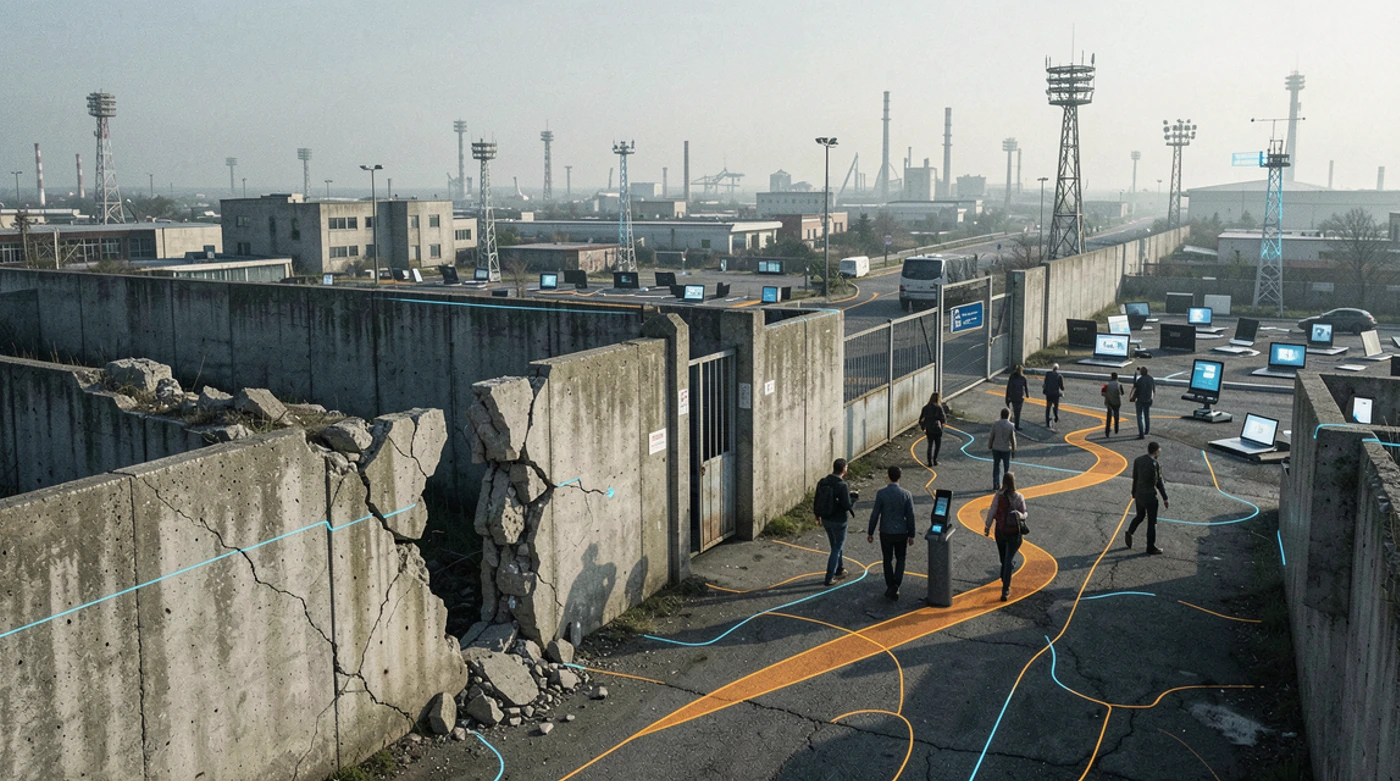
The network is no longer a trustworthy security boundary. Perimeter-era architecture assumed that location could stand in for trust, and that assumption now fails under normal operating conditions.
For a long time, the model looked reasonable. Systems ran in corporate data centers, people worked inside office networks, and traffic crossing the perimeter was a minority of total interactions. A firewall-centric design concentrated policy at a few choke points and allowed internal systems to run with broad implicit trust.
That model was not perfect, but it was coherent. Security teams could reason about north-south traffic, segment major zones, and use VPN access as a practical extension of office identity. In that world, "inside" and "outside" were imperfect but useful abstractions.
Modern infrastructure erased the assumptions underneath those abstractions. Workloads moved into cloud platforms, identity moved into SaaS providers, collaboration moved onto internet-native tools, and application boundaries moved from VLAN edges to API contracts. Remote work and partner integration made enterprise systems permanently porous. Network location stopped being a reliable proxy for intent, authorization, or risk.
Once this shift happened, perimeter controls moved from primary trust engines to supporting controls. They still matter for filtering, containment, and blast-radius reduction. They no longer decide whether a request should be trusted by default.
Thesis: Network location is now weak evidence, not an authorization primitive.
Why now: Cloud, SaaS, APIs, and remote work dissolved stable inside-outside boundaries.
Who should care: Architects, security engineers, platform teams, and technical leaders shaping trust policy.
Bottom line: Treat each interaction boundary as a trust decision point, not a routing detail.
Key Ideas
- Perimeter security optimized for a topology that no longer exists.
- VPN access established connectivity, but often expanded implicit trust zones.
- API and service interactions now carry most business-critical risk.
- Security architecture must evaluate explicit identity and policy on each request.
- Network controls remain useful, but they are no longer the source of trust.
This is Part 1 of the series. Next, read Zero Trust Is Not a Product, then Identity Replaced the Network for the trust-primitive shift.
Perimeter logic worked until topology stopped meaning trust
The classic enterprise security model used a simple proposition: if a request came from inside managed network space, grant broader access than requests from untrusted external space. Firewalls and VPN concentrators were operationally convenient because they reduced decision volume at application edges.
That convenience came from collapsing many security questions into one placement question. Is this request "in" or "out"? If it is in, many downstream systems accept it with minimal additional checks. Teams may add authentication at application entry points, but service-to-service paths inside the boundary frequently inherit broad trust by default.
In my experience, this is where the model starts to fail in modern estates. Teams continue to harden edge controls while internal trust surfaces grow without equivalent policy precision. Incident reviews then show lateral movement happening through perfectly legitimate internal paths.
The failure is architectural, not operational laziness. If the control model assumes location equals trust, policy drift will compound as systems scale.
Corporate LAN assumptions became mismatch debt
Corporate LANs once represented managed assets, managed users, and managed administrative domains. That alignment enabled coarse trust decisions because the network environment strongly correlated with enterprise control.
Today that correlation is weak. A single user session can touch SaaS systems, cloud-hosted APIs, local development tools, and third-party integrations in minutes. The same engineer may move from a managed device to a temporary contractor workstation and still require access to production-adjacent systems.
The network path no longer encodes enough truth to carry authorization semantics. It only tells you where packets appear to come from, not who is acting, what privileges are valid, and whether risk posture changed since the last check.
The operational cost of this mismatch shows up as policy exceptions. Teams create ad hoc tunnels, broad IP allowlists, and brittle bastion patterns because the old topology language cannot express modern trust intent.
Firewalls still matter, but for different reasons
A common overreaction is to claim firewalls are obsolete. They are not. Firewalls remain effective for boundary filtering, protocol hygiene, coarse segmentation, and attack-surface reduction.
What changed is role, not relevance.
[Interactive table: Responsive. This section is rendered visually on the full page.]
The strategic mistake is treating any one of these controls as sufficient evidence of trust. They are transport and boundary mechanisms. Authorization still needs identity, policy, and context.
VPN models solved transport security, not trust integrity
VPN architecture addressed a real requirement: remote workers needed secure transport into enterprise networks. Encryption, tunnel integrity, and central entry policy were useful improvements.
The trust side effect was broad network adjacency once connection succeeded. In many environments, VPN access effectively moved external devices into privileged routing zones. Authentication happened at tunnel establishment, then internal services assumed trust inherited from network position.
That pattern created two recurring failure modes:
- Compromised endpoint plus valid VPN credentials produced expansive internal reachability.
- Legitimate users inherited more access than task scope required because coarse network access replaced fine-grained authorization.
Neither issue is fixed by stronger VPN branding. Both require redesigning trust evaluation at service boundaries.
Cloud and SaaS removed the "inside" as a stable construct
Cloud adoption changed where resources run. SaaS adoption changed who controls critical systems. API ecosystems changed how systems communicate. Together they removed the idea that business-critical systems sit behind one enterprise perimeter.
In a typical production environment, core workflows traverse identity providers, cloud control planes, managed databases, SaaS observability tools, CI systems, and third-party APIs. Most of those dependencies are outside traditional network ownership.
That does not imply no boundary exists. It implies boundaries are plural, dynamic, and service-specific. Security architecture must operate across those boundaries with consistent policy intent. Network-centric models struggle because they assume a single dominant perimeter.
A practical consequence is that many high-impact security events now begin with token misuse, OAuth abuse, service account overreach, or control-plane misconfiguration rather than direct perimeter breach.
APIs turned trust into an interaction-level question
API-first systems increase coordination speed, but they also multiply trust decisions. Every endpoint and every service hop can authorize or propagate privilege. If policy assumptions are implicit, privilege diffusion is inevitable.
A request path in a modern SaaS stack may look like this: browser -> edge service -> API gateway -> control plane -> workflow service -> data service -> audit service. If only the first hop is rigorously authenticated and authorized, downstream systems operate on borrowed trust.
Borrowed trust is fragile under incident conditions. Once an attacker gains a valid token or reaches one over-privileged service, the graph of implicit assumptions creates a low-friction movement path.
Security architecture must therefore move evaluation closer to each protected resource. That is the conceptual bridge to Zero Trust, but the core correction starts here: do not let routing topology decide authorization semantics.
Field walkthrough: boundary collapse in one SaaS request path
Consider the series' canonical system: a multi-tenant B2B SaaS platform.
- Customer admins sign in through federated SSO.
- Internal operators use privileged support tools.
- Background workers process webhook events from external systems.
- A control plane orchestrates tenant configuration and policy rollout.
In perimeter-era thinking, teams often secure internet entry points and then rely on internal network segmentation for the rest. In production, this breaks quickly.
Support tools need selective tenant impersonation for break-fix work. Workers need scoped access to key material and queue credentials. Control-plane actions need high-assurance checks and audit trails. None of these conditions are meaningfully described by "inside network" versus "outside network."
The security boundary is not the subnet. It is the interaction surface where privileges are requested, evaluated, and enforced.
Pushback you will hear, and where it breaks
The first objection is pragmatic: "Perimeter controls still block a lot of attacks." True, and they should stay. The issue is coverage. Blocking unsolicited inbound traffic does not govern already-authenticated misuse, token replay, over-privileged service calls, or policy drift.
The second objection is cost-based: "Per-request checks are expensive and hurt latency." They can, if naively implemented. Mature systems use cacheable policy artifacts, short-lived credentials, and layered enforcement to reduce decision overhead while preserving trust integrity.
The third objection is organizational: "Application teams cannot own all this complexity." They should not own it alone. Platform teams provide identity, policy, and telemetry primitives. Product teams consume those primitives at boundary points. Security architecture succeeds when this division is explicit.
Design implications for system architects
If network location is weak evidence, trust decisions need better inputs.
[Interactive table: Responsive. This section is rendered visually on the full page.]
This shift is not a one-quarter migration. It is an architectural program. The key is to stop investing as if perimeter controls can carry trust semantics they were never designed to carry.
Trust-flow map
flowchart LR
  A["User or Service Request"] --> B["Transport Boundary (Firewall/VPN/API Gateway)"]
  B --> C["Identity and Context Evaluation"]
  C --> D["Authorization Decision"]
  D --> E["Resource Access"]
  E --> F["Telemetry and Audit"]
  F --> C
What changes on Monday
Perimeter controls are now supporting infrastructure, not trust arbiters. Modern security design starts by assuming that network location is ambiguous evidence and that authorization has to be explicit at each boundary where privilege is exercised.
The next essay builds directly on this correction. If the perimeter is no longer the trust source, what architecture replaces it in practice? The answer begins with a common misconception: Zero Trust is not something you buy.