
For our exploration of computing infrastructure concepts, let's follow fictional restaurant owner Jimmy, whose local establishment "The Hungry Cache" unexpectedly became the hottest spot in town. While Jimmy knows nothing about computing, his practical challenges mirror the fundamental scaling problems that today's hardware and software engineers tackle every day.
The Unexpected Success Story
When Jimmy first opened The Hungry Cache, it was a modest bar and grille with fifteen tables and a small but efficient kitchen. He never anticipated that a celebrity food blogger's Instagram post about his signature "Memory Leak" hot wings would change everything. Suddenly, weekends meant two-hour waits, overwhelmed kitchen staff, and a point-of-sale system struggling to keep up.

Vertical Scaling (Scaling Up): The Physical Limits
Jimmy's first instinct was straightforward: upgrade what he already had. He invested in a larger grill, more powerful fryers, and a high-capacity refrigeration system.
"It seemed logical," our fictional Jimmy might say. "If my kitchen was too small, I'd just make everything in it bigger and better."
This approach mirrors what experts call "scaling up" in computing—taking the capability of a computer and making it go faster with minimal software changes. Just as Jimmy upgraded his kitchen equipment, engineers often start by enhancing their servers with more RAM, better processors, and faster storage.
The strategy worked initially. Jimmy's upgraded kitchen could handle about 40% more orders per hour. But physical limitations quickly became apparent during a championship game.
"I learned the hard way that you can't just keep upgrading forever," Jimmy would explain. "I couldn't magically push back the walls to make more room. When we hit capacity, we hit a hard physical limit—no matter how fancy the equipment."
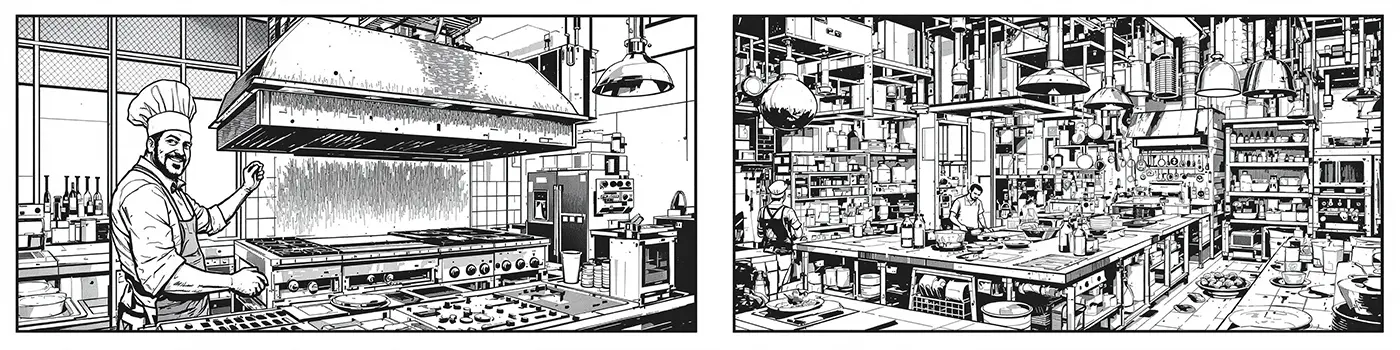
This perfectly captures the challenge of vertical scaling in computing. Just as Jimmy's kitchen had immovable walls, hardware has physical constraints that eventually cannot be overcome. A single server can only hold so much memory, no matter how densely packed the chips are. Moore's Law—the observation that transistor density doubles roughly every two years—eventually runs into fundamental physical limitations. Scale up is extremely hard to do because you're limited by the constraints of semiconductor physics.
Horizontal Scaling (Scaling Out): The Distribution Approach
After struggling with capacity issues despite his kitchen upgrades, Jimmy had a realization while driving past an empty storefront.
"Instead of one restaurant that can't grow anymore," Jimmy recalls thinking, "what if I had two normal-sized restaurants handling the customers? If one fills up, we send folks to the other."
This insight perfectly illustrates what computing experts call "scaling out"—taking algorithms and breaking them up into smaller parts that can be distributed across multiple systems. While Jimmy added a second restaurant, computing systems add more machines to distribute workload across a wider footprint.
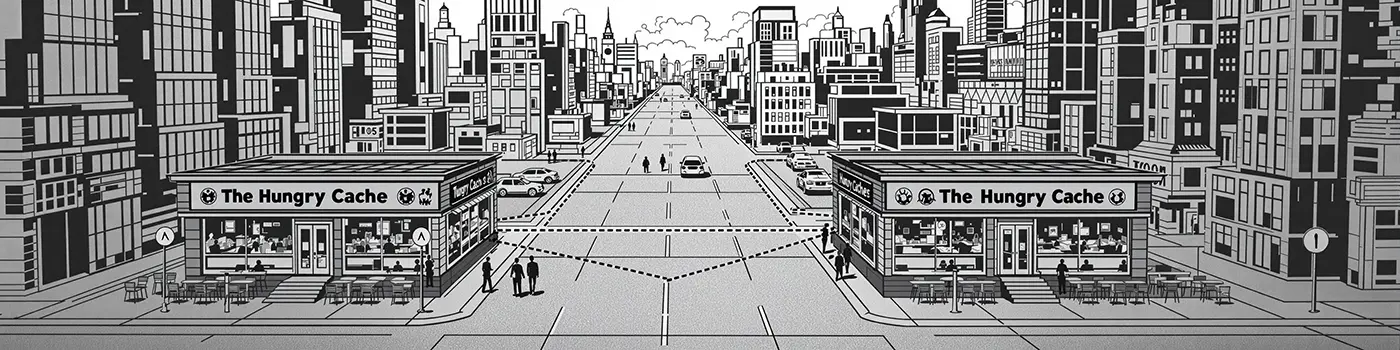
For Jimmy, the benefits were immediate. When the original location reached capacity, staff could direct customers to the second restaurant with shorter wait times.
"When that pipe burst at the downtown spot and we had to close for repairs," fictional Jimmy would explain, "we just directed everyone to our second location. Sure, it was crowded, but at least we stayed in business."
This parallels how scale-out architectures provide resilience and expanded capacity. Where Jimmy sees a backup restaurant, engineers see redundancy and fault tolerance—a system that can continue operating despite individual component failures.
Load Balancing: The Central Reservation System
As The Hungry Cache expanded to two locations, Jimmy noticed a new problem: sometimes one restaurant would have a line out the door while the other sat half-empty.
"We needed a way to even out the customer flow," Jimmy would say. "What good is having two restaurants if everyone's still waiting at just one of them?"
This led Jimmy to implement a central reservation system. When customers called, the host could see wait times at both locations and direct them accordingly.
"It's like having a traffic cop for our hungry customers," Jimmy might explain. "When someone calls for a table, we can say, 'Downtown is packed with a 90-minute wait, but our east side location can seat you in 15 minutes.'"
What Jimmy created was essentially a load balancer for his restaurant business. In computing, load balancers serve exactly the same purpose—they route user requests to the most appropriate server based on factors like current load, geographic proximity, and server health.
Without Jimmy's reservation system, customers might cluster at one location while tables sat empty across town. Similarly, without load balancing, some servers might sit idle while others crash under excessive traffic.
Elastic Scaling (Auto-Scaling): The Weekend Staff
After running both locations for several months, Jimmy noticed reliable patterns. Mondays were quiet, weekends were packed, and any time the local sports team played, they'd be overwhelmed with customers.
"It made no sense to have the same staffing every day," Jimmy would explain. "Why have eight cooks standing around on a slow Tuesday afternoon? And why have just three cooks getting crushed during a playoff game? We started scheduling based on when we knew we'd be busy or slow."
Jimmy wouldn't know it, but he was implementing what computing calls elastic or auto-scaling. Just as he adjusted staff levels based on anticipated demand, cloud platforms automatically add or remove servers based on actual usage patterns.
"I don't pay people to stand around during slow hours," Jimmy might say, "and I make sure to have extra hands when I know we'll be slammed."
This approach saves tremendous resources. In cloud computing, instead of maintaining enough servers to handle Black Friday traffic year-round, companies can automatically scale up for peak periods and back down afterward, paying only for what they actually use.
Database Scaling: The Recipe and Inventory Challenge
As Jimmy's fictional restaurant business expanded to four locations across the metropolitan area, coordinating menus, recipes, and inventory became increasingly challenging.
"At first, we tried to call each other whenever we changed a recipe or ran out of something," Jimmy would recall. "That was a disaster. The downtown location would run out of chicken wings and forget to tell the others, then customers would get frustrated when they moved to another location only to find the same problem."
Replication: Consistent Recipes Everywhere
Jimmy's first solution was to establish standardized recipe books with a clear update process.
"Every kitchen has exactly the same recipe book, page for page," Jimmy would explain. "When our head chef improves the sauce recipe, we update every book that same day. No exceptions."
In computing terms, Jimmy implemented database replication—ensuring that critical information stays consistent across multiple locations. While his concern was recipe consistency, websites use the same approach to ensure that content remains available and identical regardless of which server you connect to.
Sharding: Dividing Responsibilities
As The Hungry Cache continued expanding, Jimmy began specializing his locations.
"Each restaurant still follows our core menu and recipes," Jimmy would say, "but we've given each location its own personality. Downtown caters to the business lunch crowd with faster service and more salad options. The suburban location has a bigger kids' menu and family seating. And our spot near the stadium has the biggest bar and more TVs."
Jimmy wouldn't use this term, but he essentially "sharded" his restaurant business—dividing it along logical boundaries while maintaining core functionality. In database design, sharding works similarly by partitioning data across multiple servers based on logical divisions, allowing more efficient scaling than trying to put everything in one massive database.
"Each location handles its own inventory and staffing," Jimmy might add. "The stadium location needs way more beer during game days, while downtown needs more wine for business dinners. It wouldn't make sense to manage that centrally."
Microservices: The Food Court Evolution
After years of running traditional restaurants, Jimmy was approached about an opportunity in a new upscale food hall. Instead of another full-service restaurant, he could open specialized stalls.
"It was a totally different setup," fictional Jimmy might recall. "Instead of one big kitchen doing everything, we opened three separate stalls—one just for our famous wings, another for burgers, and a third for desserts."
In computing terms, Jimmy had stumbled upon the microservices architecture pattern. While he saw specialized food stalls, engineers see specialized services handling specific functions like user authentication, payment processing, or recommendation engines.
"The wing stand gets completely slammed during big games," Jimmy would explain. "Now we can just add extra staff there without changing anything at the dessert counter. It's way more flexible."
This perfectly illustrates one of the key benefits of microservices in computing—the ability to scale individual components independently based on their specific demand patterns. While Jimmy adds cooks only to his busy wing station, Netflix might scale up their video streaming service during evening peak hours while keeping their account management service at baseline capacity.
Serverless: The Catering Side-Business
Even with multiple restaurants and food stalls, Jimmy saw opportunities he couldn't efficiently capture—corporate events, weddings, and private parties.
"A dedicated event space would be financial suicide," fictional Jimmy would explain. "I'd be paying rent, utilities, and maintenance all year for something that might sit empty half the time. Instead, we created a catering operation that only runs when someone books an event."
What Jimmy described with his catering business perfectly parallels serverless computing. Just as his catering team assembles only when an event is booked, serverless functions activate only when triggered by specific events.
"We don't pay for anything until someone books us," Jimmy might say. "Then we rent the equipment we need, bring in exactly the right number of staff, and scale it all based on the event size. A dinner for 10 gets very different resources than a corporate event for 500."
In computing terms, this is exactly how serverless platforms operate—resources scale precisely to match demand, with no costs during idle periods. Just as Jimmy wouldn't maintain a permanent wedding venue for occasional bookings, companies don't need dedicated servers for functions that run infrequently.
Parallel Processing: From Single Kitchen to Multiple Stations
As Jimmy's business evolved, he made a key observation about his kitchen operations.
"We used to have each cook try to handle complete orders," Jimmy might explain. "But then we reorganized. Now we have the grill station, the fryer station, and the prep station all working in parallel. Three cooks can put out way more food when they're not stepping on each other's toes."
This kitchen reorganization represents the concept of parallel processing in computing. Just as Jimmy's kitchen became more efficient by having specialized stations working simultaneously, GPUs achieve incredible performance by executing many operations in parallel. Traditional CPUs might be like a single talented chef trying to do everything, while GPUs are like a well-organized kitchen with many specialized stations working in harmony.
"It's not just about having more hands in the kitchen," Jimmy would say. "It's about organizing the work so those hands don't get in each other's way."
This mirrors the fundamental innovation of modern parallel computing—creating a programming model that makes parallel operations look like a single application while distributing work across thousands of cores.
The Sequential Bottleneck: The Check-Out Process
Despite all his kitchen improvements, Jimmy noticed one persistent bottleneck.
"No matter how fast we make the food," Jimmy would explain, "every customer still has to pay individually at the register. We can have ten cooks working in parallel, but if we only have one cash register, customers still end up waiting in line at the end."
Without knowing it, Jimmy has discovered Amdahl's Law in computing. This principle states that the sequential portions of a workload limit the benefits of parallelization.
If 10% of a process must be done sequentially, then even with infinite parallelization of the remaining 90%, you can only achieve a maximum 10x speedup. This is why, even in a highly parallel computing world dominated by GPUs, high-performance CPUs remain essential for handling sequential tasks. Just as Jimmy needs both efficient parallel food preparation and a streamlined sequential checkout process, computing systems need both massive parallel processing power and excellent single-threaded performance.
Precision and Efficiency: The Recipe Adjustment
After running his restaurants for several years, Jimmy made an interesting discovery about his recipes.
"We used to measure everything with extreme precision," Jimmy might recall. "But we realized for most dishes, we don't need to measure to the gram. For our wing sauce, whether it's exactly 2.0 or 1.9 grams of a spice makes no real difference to the customer. By being a bit more flexible with measurements, our cooks work faster and customers are just as happy."
This practical adjustment parallels one of the key innovations in GPU computing for AI—reduced precision. While traditional computing often requires high-precision calculations (FP32 or FP64), AI workloads can often use lower precision (FP16 or even FP8) without affecting the quality of results.
Every step down in precision effectively quadruples computation or reduces energy consumption by a factor of four. Just as Jimmy's kitchen became more efficient by relaxing unnecessary precision requirements, GPUs achieve massive performance gains and energy savings by matching precision to actual needs.
Cloud Computing Models: The Franchise Approach
As The Hungry Cache brand grew, Jimmy faced a decision: should he own and operate every new restaurant, or allow franchises?
"Owning every location would have required enormous capital investment," Jimmy might explain. "With franchising, other people provide the building and equipment while following our proven business model. We can grow much faster this way."
This franchise approach mirrors cloud computing models. Rather than building their own data centers, companies can leverage cloud providers' infrastructure. The cloud offers several scaling approaches:
Infrastructure as a Service (IaaS): The Equipment Rental
"Some of our franchise partners already had restaurant experience and just wanted our brand and recipes," Jimmy would say. "We provide the menu and basic requirements, but they handle most operations themselves."
This is like Infrastructure as a Service (IaaS) in cloud computing, where providers supply fundamental computing resources (servers, storage, networking) while customers deploy and manage their own applications and data.
Platform as a Service (PaaS): The Kitchen-Ready Space
"Other partners want more support," Jimmy continues. "We provide not just the menu but standardized kitchen layouts, equipment specifications, and operational systems. They focus mainly on customer service and local marketing."
This parallels Platform as a Service (PaaS), where cloud providers deliver a complete platform including hardware infrastructure, operating systems, and development tools. Customers just deploy their applications without worrying about the underlying infrastructure.
Software as a Service (SaaS): The Turnkey Operation
"Our newest model is almost completely turnkey," Jimmy explains. "We handle menu development, staff training, inventory management systems, marketing campaigns—nearly everything. The local owner mostly manages day-to-day operations following our systems."
This resembles Software as a Service (SaaS), where providers deliver complete applications over the internet. Customers simply use the software without concerns about infrastructure, platforms, or application management.
Containerization: The Standardized Kitchen Module
One of Jimmy's most innovative ideas was developing standardized kitchen modules.
"We designed compact, efficient kitchen units that can be installed almost anywhere," Jimmy would explain. "Whether it's going into a mall food court, an airport, or a standalone building, the kitchen core is identical—same equipment, same layout, same workflow. This makes training consistent and allows staff to work at any location without relearning everything."
This standardization mirrors containerization in computing. Containers package applications and their dependencies into standardized units that can run consistently on any infrastructure—development laptops, test servers, or production cloud environments. Just as Jimmy's standardized kitchens ensure consistent operations regardless of location, containers ensure applications run identically regardless of the underlying computing environment.
Geographic Distribution: The Regional Expansion
As The Hungry Cache gained national recognition, Jimmy began receiving franchise inquiries from across the country.
"I realized pretty quickly that what works in our city might not work everywhere," Jimmy would explain. "And I couldn't exactly ship prepared food across the country. The wings would be terrible by the time they arrived!"
Jimmy's solution was to establish regional kitchens that followed his core recipes but adapted to local tastes and sourced ingredients locally.
"Every Hungry Cache has the same foundation and standards," he might say. "But our Texas franchise uses local peppers in the wing sauce, and our New England location has an expanded seafood section. You can't ignore regional differences."
Jimmy has essentially created a content delivery network (CDN) for his restaurant concept. Just as CDNs store website content in data centers worldwide to reduce loading times, Jimmy positioned his restaurant concept closer to customers while allowing for necessary regional adaptations.
The Integrated Approach: When One Solution Isn't Enough
As our fictional Jimmy reflects on his path from a single restaurant to a national brand, he sees how different strategies solved different problems.
"I tried everything to keep up with demand," Jimmy might say. "Bigger equipment only got us so far. Multiple locations helped spread the load. Specialized stations made our kitchens more efficient. Better coordination systems connected everything together. And adjusting our precision requirements saved time without affecting quality. No single approach would have been enough—it took all of them together."
What Jimmy doesn't realize is that he's describing exactly how modern computing hardware and systems have evolved. Where Moore's Law once provided predictable scaling through transistor density improvements alone, today's computational advances require a multi-faceted approach combining:
- Traditional vertical scaling (more powerful individual components)
- Horizontal scaling (more machines working together)
- Specialized hardware architectures (like tensor cores)
- Reduced precision where appropriate (FP16/FP8)
- High-speed interconnects between processing units
- Efficient parallelization of algorithms
- Full-stack optimization across hardware and software
The Scaling Playbook
Though Jimmy and The Hungry Cache exist only in our imagination, the scaling principles illustrated by his restaurant business mirror the real hardware and software challenges that technology companies face daily. Computing infrastructure has evolved through the same kinds of practical problem-solving that guided our fictional restaurant owner—identifying bottlenecks, removing constraints, and combining multiple strategies to meet growing demands.
From scaling up a single kitchen to scaling out across multiple locations, from specializing equipment to optimizing workflows, Jimmy's restaurant growth parallels the evolution of modern computing. The multi-dimensional scaling approaches that transformed his local bar and grille into a national brand are the same strategies that have enabled the computational revolution powering today's digital experiences.
The next time you use an AI-powered application, play a graphically intensive game, or browse a website that handles millions of simultaneous users, remember that behind those experiences are scaling systems that have evolved through the same practical decisions that guided our fictional restaurant owner—just with more silicon and fewer hot wings.