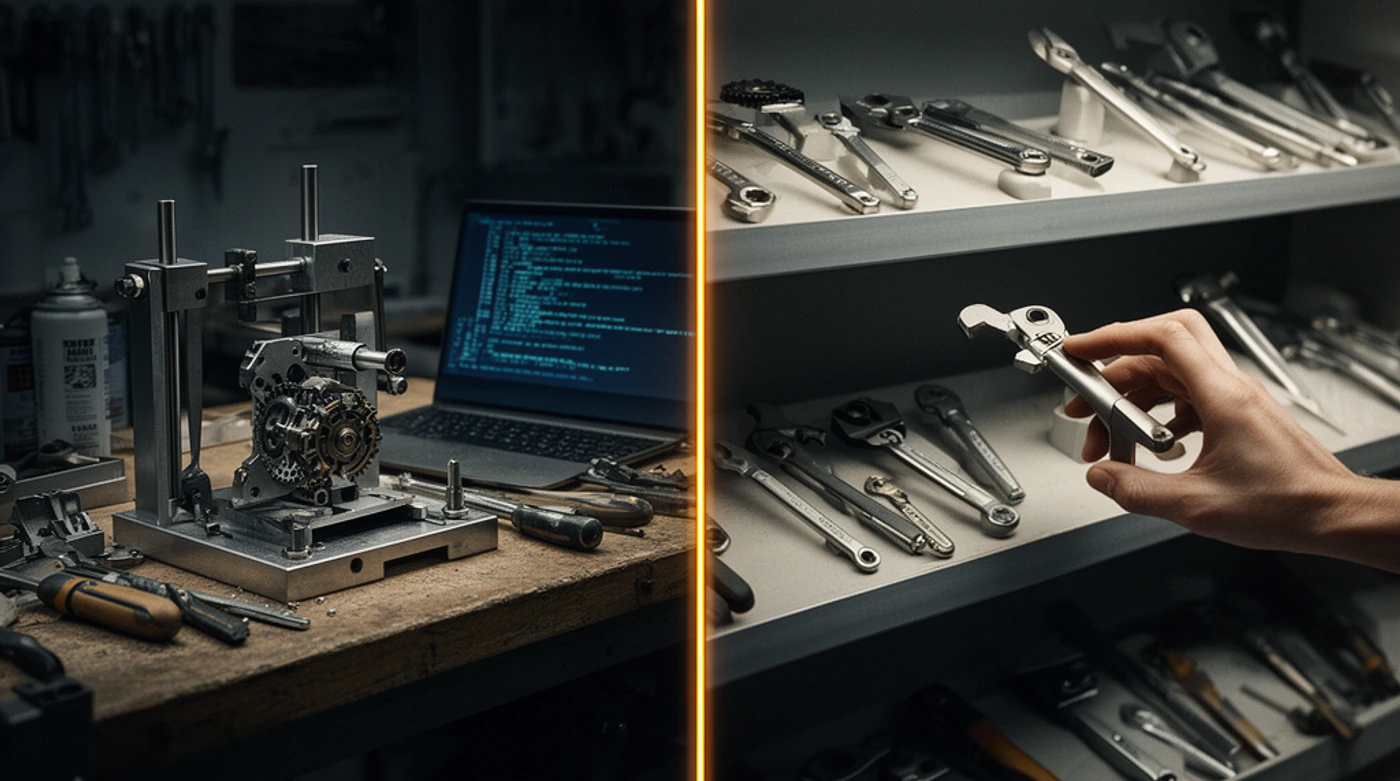
My partner can find a restaurant, compare options, and book the table before I finish refining a search query.
I can usually extract exactly what I need from a system, but I do it with a scalpel. She gets to usable answers fast with a sweep.
That contrast appears everywhere. If a tool behaves slightly wrong, my first instinct is to modify the tool. If a tool behaves slightly wrong for her, her first instinct is to replace the tool. I tune the mechanism. She tunes the choice.
I am in my mid-forties and built competence as the internet matured. She is in her mid-twenties and grew up inside mature abstractions. I learned by interrogating internals because internals were often the only path to reliability. She learned by navigating surfaces because the surfaces were usually good enough to move quickly.
Neither style is superior. Both are adaptive.
But the difference is not cosmetic. It shapes how we interpret friction, how we price time, and how optimization instinct spills into domains that are not tools, including love.
I used to write this as a clean framework. That was accurate and incomplete. The fuller story includes pride, fear, tenderness, and the uncomfortable fact that my strongest professional instinct can become relational pressure when I apply it everywhere.
If you are a builder, founder, or operator who feels both proud and exhausted by your own optimization reflex, this essay is for you. It maps where that reflex creates real leverage, where it quietly creates distance, and how to keep your agency without turning every imperfect moment into a project.
In this essay, you will get a practical way to decide when to build, when to move, and how to repair the relational cost when your correction instinct lands too hard. This piece focuses on full-story decision fitness, not personality typing.
Companion essay: The Age Mismatch Problem covers identity lag and time asymmetry. This one focuses on mechanism choice under stress.
Thesis: Some people meet friction by modifying the system. Others meet friction by navigating around it.
Why now: Abundant tools reward fast selection, while many builders still run optimization patterns forged in scarcity.
Who should care: Builders, operators, founders, and anyone in close relationships where one person rebuilds and the other reroutes.
Bottom line: The skill is not abandoning the workshop. The skill is choosing when the workshop is actually worth entering.
I. The Small Moments That Explain the Big Pattern
The pattern shows up in trivial scenes.
A cabinet door sits slightly off-center and closes with a soft scrape. I feel a low-grade itch until I adjust the hinge. My partner notices the same scrape and asks, "Does it matter enough to spend an hour on this tonight?"
A travel plan has three imperfect options. I start comparing constraints, edge cases, failure scenarios, and local workarounds. She picks the best acceptable route in ten minutes and moves on.
A meal is "good enough." I start asking what could make it better next time. She enjoys what is there.
None of these scenes are dramatic. That is what makes them important. Your default mode is most visible in low-stakes moments, because those are the moments where identity acts without supervision.
I used to think these moments did not matter because they were tiny. But tiny moments are where relational climate is built. If every small imperfection gets met with correction energy, people around you can start feeling like they are always in a live performance review.
II. Where My Reflex Came From
At this point, the personal origin matters.
I did not become a modifier because it sounded intelligent. I became one because it worked in the environments that shaped me. If something broke, there often was no easy substitute. If money was tight, replacing things casually was not a real option. If a system was clumsy, living with it meant recurring frustration, so fixing it became normal.
Over time, that produced a loop:
- notice friction quickly
- assume responsibility for improving it
- reduce repeat pain
- attach agency to intervention
This loop built competence and confidence. It also created an identity contract: if I can improve it, I should improve it.
That contract is useful and costly. Useful because it creates leverage where recurrence is real. Costly because it turns ordinary imperfection into a personal assignment.
There is also a dignity story inside this. Learning to repair, adapt, and build gave me a sense that I could handle life without waiting for perfect conditions. I do not want to lose that. The goal is not unlearning competence. The goal is unlearning compulsory intervention.
III. What Modification Gives Me Emotionally
There is a reason this pattern is hard to change.
Modification does not only solve tasks. It regulates emotion. When I improve a mechanism, uncertainty drops. Ambiguity becomes structure. Helplessness becomes action.
That feels good. It feels clean. It feels like dignity.
The risk is obvious once you see it: sometimes I am optimizing because optimization is economically correct, and sometimes I am optimizing because uncertainty makes me feel exposed.
Vulnerable truth: I have used "high standards" to hide anxiety I did not want to name.
When I say that out loud, mode selection gets easier. When I do not, everything becomes a mechanism problem.
At this point, I also had to admit that optimization can be a socially rewarded defense. People often praise visible competence, so you can hide emotional avoidance behind productivity and still get applause. That makes the pattern harder to detect because it looks like excellence from the outside.
Inside, it can feel like never fully exhaling.
IV. The Cost I Did Not Want to Admit
For years I measured this trait mostly by its professional upside. That was an incomplete accounting.
The hidden costs looked like this: delayed decisions in low-consequence contexts, emotional fatigue from constant quality scanning, and relational pressure when people around me did not want every rough edge treated as a design flaw.
My partner felt this before I did. She would ask for a simple evening and I would drift into improvements: reorganizing a process, revising a plan, tuning details that were technically better and emotionally mistimed.
From my side, it felt like care. From her side, it sometimes felt like there was no room to breathe inside my pace of correction.
Both interpretations were honest.
The emotional cost was cumulative. She felt watched. I felt unappreciated. Neither of us used those words at first. We used safer words like "communication" and "timing." Underneath was a deeper mismatch about how safety is created. My safety strategy was control through refinement. Her safety strategy was trust through presence.
Neither strategy is wrong. But if unspoken, they can injure each other.
V. The Conversation That Changed My Framing
One night she said something that stayed with me: "I know you are trying to make things better. But sometimes I feel like I am being managed, not loved."
That sentence cut through my usual defenses.
I wanted to explain intent, context, and logic. Instead I sat with the impact. I could finally see that intent and impact were diverging in repeatable ways.
I was importing workshop logic into intimacy. In workshop domains, intervention often improves outcomes. In relationships, over-intervention can erode trust if it compresses autonomy, pacing, or emotional space.
So far, this has been the most useful reframe: the question is not "am I right to optimize?" The question is "what system am I in, and what does this system actually reward?"
That conversation did not fix everything in one night. It gave us a starting language. For a while I would still drift into correction mode and she would still pull away. The difference was that we could name the loop faster and reset before it became character assassination.
I started practicing one sentence when I felt the correction impulse rise: "Do you want support, structure, or just company right now?" That sentence saved us from dozens of unnecessary arguments.
VI. Builder Versus Selector Is an Economics Lens
Once we moved out of personality language, things got simpler.
| Decision variable | Usually favors selector mode | Usually favors builder mode |
|---|---|---|
| Recurrence | Rare or one-off | Frequent and predictable |
| Failure cost | Low downside | High downside or trust risk |
| Switching cost | Easy replacement | Painful replacement |
| Reversibility | Easy to undo | Expensive to undo |
This table is not perfect. It is practical. It turns style conflict into explicit tradeoffs.
At this point, I can often predict conflict by checking whether we silently disagree on one of these variables.
Now we can add one more variable that does not fit neatly in the table: emotional bandwidth. A technically correct intervention can still be the wrong move if the people involved do not have capacity to absorb it well in that moment.
Constraint analysis without emotional timing can still fail.
VII. Two Personal Case Studies
The first case was home budgeting workflow. We kept running into small monthly confusion about subscriptions, discretionary spend, and shared commitments. It was not a crisis, but it repeated and produced low-grade tension. Recurrence was high, failure cost was relational trust and stress, and reversibility was moderate once habits formed.
Builder mode won. We created a lightweight shared review rhythm and simple categories we both understood. The system reduced friction immediately.
The second case was a kitchen organization project I pushed hard to "solve." I designed a cleaner storage layout and wanted everything standardized. Recurrence of the pain was actually low, switching cost was trivial, and reversibility was high. The project became a needless source of tension and spent energy.
Selector mode should have won. I was optimizing for identity comfort, not meaningful leverage.
The contrast between those two cases changed my behavior more than any abstract principle.
I began keeping a "build log" for a month. For each intervention impulse, I wrote down context, chosen mode, and outcome after one week. The pattern was humbling. My highest-value interventions were fewer than I imagined, but they were very high value. Many other interventions were neutral or negative once relational and attention costs were included.
That data reduced shame and reduced ego. I was not "too much" as a person. I was sometimes misallocating a real strength.
VIII. Work Case: Where Builder Mode Still Dominates
I still rely heavily on builder mode in high-consequence work.
In one operational context, we had a recurring seam that produced small errors individually and expensive outcomes in aggregate. The issue looked manageable in any single instance, which made it easy to postpone. Recurrence and consequence justified intervention, so we redesigned the handoff and removed the failure class.
This is important because the point is not to become passive. The point is disciplined intervention.
When failure compounds, building is responsibility.
When friction is transient and reversible, building can become vanity.
A useful test I now run is this: if I do nothing for two weeks, what actually breaks? If the answer is "almost nothing," I probably do not need a redesign tonight.
IX. So Far, the Pattern Is Clear
So far, my best decisions came from mode selection before action, not from intensity after action.
When I choose mode by constraints, I usually like the result even if the process is imperfect.
When I choose mode from identity, I often get polished outcomes with hidden costs.
At this point, the maturity move feels less glamorous: fewer heroic interventions, better timing, cleaner allocation.
Doctrine callout: Explore by sweep. Stabilize by scalpel. Do not confuse phase with identity.
This sentence has become a practical rule in work and home life.
X. A Coordination Script We Actually Use
The best framework in the world is useless if you cannot apply it mid-conversation.
This short script is what we use when a decision starts looping:
- Define the decision horizon in one sentence.
- Name downside if wrong.
- Score recurrence and reversibility quickly.
- Choose builder, selector, or hybrid mode.
- Set one checkpoint for reconsideration.
The script keeps us from moralizing style differences. It also creates a shared record of assumptions, so we can update without ego when new evidence arrives.
The hidden win is emotional. This script gives both people dignity. The builder does not have to pretend optimization instincts are bad. The selector does not have to pretend speed instincts are shallow. Both get to be intelligent in public.
XI. Where I Choose Acceptance on Purpose
Now we can discuss the part I resisted most.
I have started choosing acceptance intentionally in domains where optimization return is low and emotional cost is high. Not surrender. Selection.
Examples include minor household imperfections, low-consequence social logistics, and aesthetic preferences where no serious downside exists. In these spaces, forcing structural precision usually steals more life than it saves.
This shift was harder than I expected because my identity liked being the person who could improve anything. Letting some things remain imperfect felt, at first, like lowering standards.
Eventually it felt like reclaiming attention.
Here is what this means in practice:
- not every friction point deserves architectural energy
- some problems are solved by timing, not mechanism
- peace can be a higher-order optimization target
I want to be specific here because this sounded abstract to me at first. Choosing acceptance has looked like leaving a crooked picture frame alone for a week, letting a plan stay 80% defined before a trip, and not turning every shared routine into a process upgrade. None of these choices made my life worse. Most made my evenings better.
At this point, I can feel the difference in my body. Correction mode tightens me. Presence mode softens me. Neither is always right. But noticing the physiological signal helps me catch compulsive optimization earlier.
XII. The Leadership Layer
This dynamic also changed how I lead.
I used to over-index on builder standards early in ambiguous projects. That improved local quality and sometimes slowed global learning. I now separate exploration and hardening more deliberately.
Exploration phase rewards selector behavior: broad option scans, quick experiments, low attachment, rapid discard.
Hardening phase rewards builder behavior: mechanism clarity, test discipline, failure containment, and interface stability.
Teams perform better when both modes are legitimate and sequenced. They perform worse when either mode is treated as moral superiority.
This changed who I reward on teams too. I used to over-reward visible builders and under-reward people who prevented waste by choosing not to over-engineer. Now I treat mode accuracy as a core skill. Good judgment is not maximum intervention. Good judgment is proportionate intervention.
XIII. What Changed After Ninety Days
The most obvious change was emotional load. I felt less constant background urgency to intervene.
The second change was relational quality. My partner no longer had to defend ordinary pace against my default acceleration as often. I no longer interpreted her adaptability as lack of seriousness.
The third change was output quality. I still build deeply where compounding value exists, but I spend less premium attention on low-consequence surfaces.
This produced an unexpected outcome: more consistency, less exhaustion.
I did not lose agency. I stopped leaking it.
I also became easier to live with. That might be the metric I am most proud of, even if it is less glamorous than technical accomplishments.
XIV. The Fear Underneath
If I am honest, part of my old pattern came from fear of becoming passive or irrelevant. If I stopped fixing things, who was I?
That fear makes sense for people whose competence story was built through intervention. It is still fear.
I had to learn that restraint is not passivity. Sometimes restraint is higher-quality agency because it protects attention for what actually matters.
Human note: Maturity is not solving fewer things. It is solving the right things at the right depth.
This is not a one-time insight. I relearn it constantly.
Some days I still fail fast. I still overcorrect, overplan, and over-own. The difference is recovery speed. I notice sooner, apologize sooner, and reset sooner. That is what progress looks like for me right now.
XV. Limits of the Model
This framework has limits.
Not every decision deserves analysis. If downside is trivial and reversibility immediate, do not turn dinner into a strategy offsite.
Also, builder versus selector should never become identity prison. People are not fixed types. The same person can switch modes by context, capacity, and stakes.
Finally, mode language can be weaponized in relationships if one person uses it to dominate rather than coordinate. If that is happening, stop using the framework and address trust directly.
Frameworks are tools. They are good only when they improve care and decisions at the same time.
If the framework helps you win arguments but worsens your relationships, it is not wisdom. It is strategy without love.
XVI. What Repair Looks Like in Real Time
The framework helped. Repair behavior made it real.
For me, repair usually starts the same way: I notice I have moved from collaboration into management tone. My questions become narrower, my voice gets clipped, and I start solving three steps ahead without checking whether that was requested.
When I catch it early, I use a direct repair pattern. First, name the behavior without self-justifying it. Second, name impact as you understand it. Third, ask what would feel better right now. Fourth, follow through quickly.
This sounds basic. It is difficult in the moment because my reflex is still to explain why I was being efficient, responsible, or correct.
Correctness is rarely the missing ingredient in these moments. Safety is.
One evening we were deciding a family logistics issue with multiple moving parts. I began optimizing sequence and contingencies before we had aligned on priorities. The conversation tightened fast. Instead of pressing harder, I paused and said: "I am in build mode and I can feel that I am crowding the room. Do you want me to switch to listening mode for five minutes?" We reset, aligned priorities first, and then used structure where it was actually helpful.
That is what progress looks like for me now. Not perfection. Faster noticing and cleaner repair.
XVII. A Full Story Day: Same Reflex, Two Outcomes
At this point, the most useful evidence is ordinary life.
Same day, two situations, same person, different mode outcome.
Morning: I noticed a recurring billing issue in a shared account. It had repeated for months and generated tension every cycle. Recurrence high, downside moderate, reversibility medium. I proposed a simple fix, we agreed quickly, and the issue disappeared. Builder mode created relief.
Afternoon: we were choosing where to eat after a long day. I started researching menus, travel times, seating flow, and backup options while she just wanted to pick something decent and spend time together. Recurrence low, downside trivial, reversibility immediate. I was still in builder mode and turned a simple choice into friction. Selector mode would have been better.
The embarrassing part is that both situations happened within hours. The hopeful part is that once I saw it, I could not unsee it.
This is why I no longer trust intensity as a quality signal. Intensity tells me I care. It does not tell me I am choosing the right mode.
Now we can name the central lesson in plain language: the same reflex can be wisdom in one context and noise in the next. Maturity is not deleting the reflex. Maturity is contextualizing it before it leaks cost.
That shift has made me more effective at work and more gentle at home. I do not always get it right. I do get back to center faster.
One more thing changed that surprised me. I became less tired even when my workload stayed heavy. Constant correction has a hidden metabolic cost. Your mind is always scanning for defects, always preparing interventions, always carrying unfinished upgrades in the background. When you reserve builder mode for high-leverage contexts, that background load drops.
The practical result is not laziness. It is cleaner energy. I still push hard where it matters, but I am no longer spending top-tier focus on every imperfect surface. That has improved the quality of my attention in conversations, not only the quality of my outputs.
For anyone who shares this reflex, this is worth testing. Keep your standards. Keep your craft. Just stop confusing universal intervention with integrity. Sometimes integrity is the discipline to leave a low-consequence imperfection alone and invest that attention in people, health, and high-consequence work.
XVIII. Closing Frame
She finishes the task. I redesign the universe in which the task exists.
She optimizes for momentum. I optimize for structure. She trusts the surface. I interrogate the seams.
The world still needs builders. It also rewards selectors more than it did when I started.
The danger is not that one mode is wrong.
The danger is choosing mode from identity loyalty instead of constraint reality.
If this essay lands for you, try one concrete move this week: find a recurring friction point and classify it honestly before you act. Then choose mode on purpose.
Perhaps the skill is not abandoning the workshop, but entering it with consent from reality.
Agency is powerful. Acceptance is powerful. Judgment is knowing which one this moment requires.