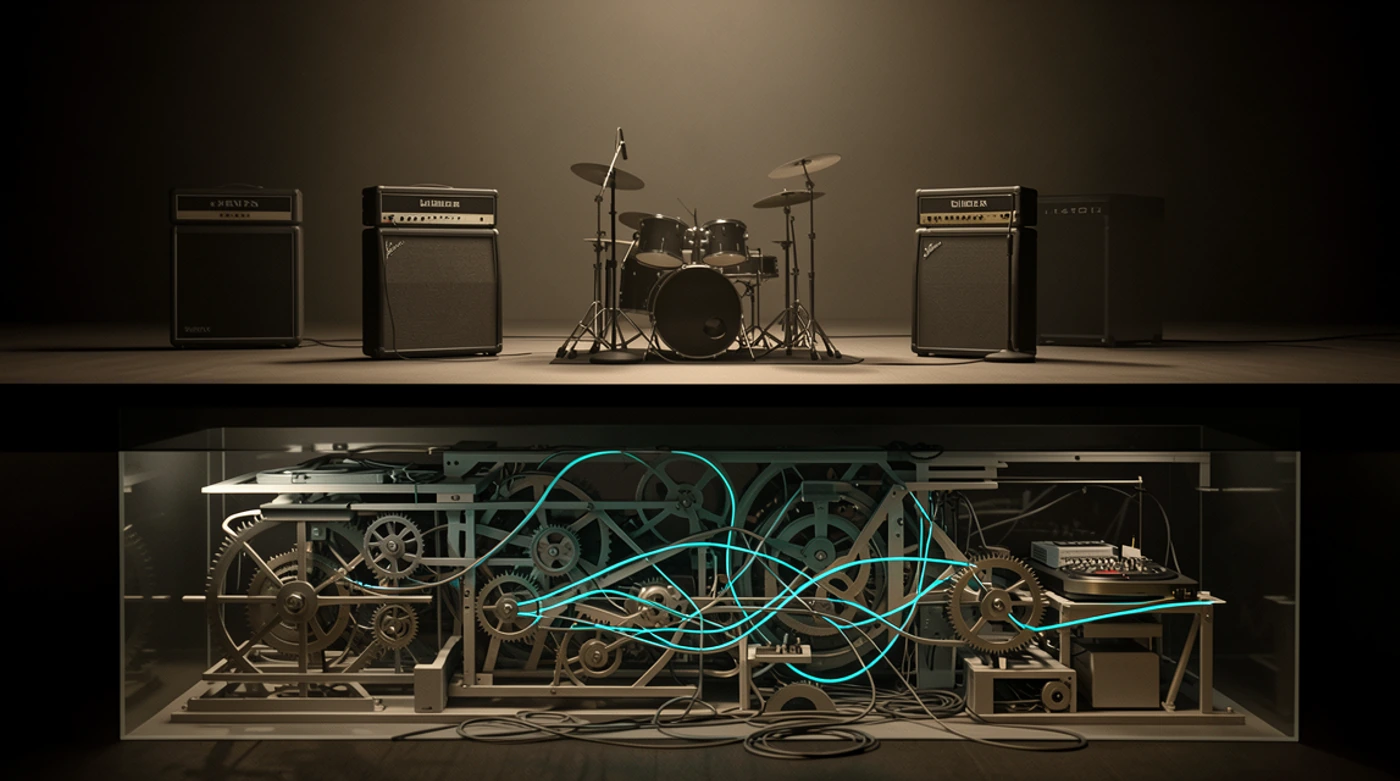
People often use the wrong metric for musical intelligence. They assume sophisticated music should look difficult from across the room: fast hands, dense voicings, visibly hard execution, and constant signs of technical strain. If you can see the effort, they call it advanced. If it feels obvious, they call it simple.
That assumption breaks the moment you spend serious time with great records. Some of the strongest songs in modern rock and alternative music sound almost elementary at first pass. You hear a direct riff, a memorable melody, and a groove that lands instantly. Nothing announces itself as "complex" in the way a classroom demonstration does. Then you isolate tracks, map section movement, and discover that the song is carrying far more architecture than surface listening reveals.
The guitar may be stable while the bass line quietly shifts harmonic function. The vocal may appear conversational while its phrasing creates tension against the rhythmic grid. The arrangement may feel natural while it controls exactly when information appears and disappears. In other words, the music feels easy because the engineering is strong, not because the writing is naive.
If you write, arrange, or produce, this distinction changes everything. It changes what you practice, what you listen for, and how you judge whether a section is actually finished. It also protects you from a common professional trap: over-valuing visible complexity and under-valuing structural interaction. In this post you will get a practical model for hearing hidden complexity, writing with interaction in mind, and debugging arrangements that sound "impressive" but feel emotionally flat.
Thesis: Sophisticated music often hides complexity in relationships between parts rather than displaying complexity in each part.
Why now: Production tools make technical display easier every year, but relational composition and restraint are still scarce.
Who should care: Songwriters, producers, session players, and serious listeners who want to understand why some songs age better than others.
Bottom line: The highest musical craft is complexity you feel without consciously noticing.
The illusion starts in how people listen
Most listeners do not experience songs as technical diagrams. They experience them as emotional events. They track melody shape, rhythmic energy, contour, and impact. They usually do not track inner voice movement, subtle substitutions, or micro-timing offsets unless they are specifically trained to hear those dimensions.
This is not a deficiency. It is exactly how efficient perception works. A listener is supposed to receive the song, not audit every mechanism inside it.
| Perceptual foreground | Perceptual background |
|---|---|
| Hook and melody identity | Internal harmonic routing |
| Groove and pulse stability | Counterline logic between instruments |
| Energy and emotion arc | Micro-timing tension and release |
| Section impact | Arrangement-level information choreography |
The key anchor is simple: surface legibility and structural sophistication are not opposites. In strong records, they are designed together.
So far, the main point is perception: listeners and musicians both over-index visible effort. The next layer is engineering: where complexity actually sits when songs are built to last.
Complexity lives in interaction space
A part-by-part evaluation model misses where much of the craft actually sits. Many musicians ask, "Is this part hard?" The better question is, "What does this part do to the system once other parts are present?"
A stable guitar figure can become harmonically dynamic when the bass line moves with intention. A straightforward kick-snare pattern can feel urgent or relaxed depending on hi-hat placement and vocal consonant timing. A melody that looks plain in notation can become emotionally unstable when it lands on changing chord tensions. Nothing here needs to sound academic in the final record. The mechanism disappears into the experience.
That disappearance is a feature, not a bug. Musical design quality often increases as mechanism visibility decreases.
Key Insight: If complexity is obvious in every layer, the song may be signaling effort rather than delivering meaning.
Rock examples that hide architecture in plain sight
Nirvana and the "Teen Spirit" misunderstanding
"Smells Like Teen Spirit" is often treated as a beginner-level harmonic event because the core guitar movement is straightforward to learn. That interpretation confuses playable part complexity with compositional system complexity. The track's force depends on interaction between low-end movement, dynamic section contrast, and vocal phrasing pressure. The riff is the entry point, not the total architecture.
Stone Temple Pilots and low-end intelligence
A large part of Stone Temple Pilots' durability comes from interaction design, especially in low-end writing. You frequently hear bass movement that does more than reinforce roots. It redirects emotional color under familiar rock textures. Chordal language can carry extension and implication without announcing itself as theory content. Most listeners simply hear conviction and depth. The mechanism remains masked.
Eleven, Alain Johannes, and "Reach Out"
To be specific, this is exactly why the band Eleven is such a useful example, especially in "Reach Out." In that writing approach associated with Alain Johannes (alongside Natasha Shneider in Eleven's core creative identity), the song can hit with immediate rock directness while carrying dense harmonic and timbral information under the surface.
In "Reach Out," the surface read is powerful and straightforward. Underneath, the arrangement is doing quiet structural work through voicing color, spacing decisions, and layered texture interaction that avoids blur. The result is complexity that feels emotionally inevitable rather than intellectually announced. That is mature control: dense information delivered without cognitive noise.
The second anchor is worth keeping: great songs often feel obvious in hindsight because the complexity has been compressed into coherence.
Why musicians still overvalue visible complexity
Musicians are trained in public. Public settings reward demonstrable effort. Fast runs are obvious. Dense substitutions are obvious. Difficult techniques are obvious. Structural decisions that improve song outcome while reducing local flash are usually less obvious in rehearsal-room culture.
This bias creates predictable failure modes. Parts get crowded because each player wants their line to prove value in isolation. Rhythmic lanes overlap without hierarchy. Harmonic motion gets added where contour would have been enough. The section becomes technically rich and emotionally flat.
| Goal | High-risk default | Higher-leverage move |
|---|---|---|
| Add depth | Add notes to every lane | Add intentional relationships between lanes |
| Raise intensity | Keep density constant and high | Alternate pressure and release |
| Show capability | Prioritize isolated part difficulty | Prioritize total-system emotional result |
| Sound advanced | Push obvious complexity to foreground | Hide complexity in controlled interaction |
A capable player can still make weak arrangement decisions. Technique is capacity, not automatically judgment.
The craft of hiding mechanism
Hiding mechanism requires compositional restraint. Restraint is not minimalism as an aesthetic pose. It is selective exposure of information over time. You are deciding what the listener should consciously track and what should remain structural support.
A practical way to frame this in sessions is to assign roles before adding layers. Decide which element carries harmonic movement, which carries rhythmic instability, and which layer must remain stable enough to preserve orientation. If every lane carries both movement and instability, clarity collapses.
The same logic applies to doubling. Doubling can strengthen identity, but unnecessary doubling can erase useful ambiguity and reduce depth. One of the hardest professional decisions is deleting a technically impressive line because it interferes with the higher-level argument of the song.
Key Insight: The audience does not reward how many decisions you made. They reward whether the song feels inevitable.
How to hear hidden complexity on purpose
You can train this perception. Use a repeatable multi-pass listening method on songs you trust.
- First pass: capture only emotional arc and section-level pressure changes.
- Second pass: isolate low-end movement and map where harmonic function shifts.
- Third pass: note rhythmic displacement, especially vocal consonant timing against grid accents.
- Fourth pass: trace information reveal strategy across sections.
- Fifth pass: identify what is intentionally absent and why that absence works.
Then run a production test: rebuild a 60-90 second segment with fewer layers while preserving emotional force. If force survives reduction, the section is structurally sound. If force collapses, the original likely depended on surface density more than interaction quality.
This drill does more than improve listening. It rewires writing instincts.
A short arrangement surgery example
Imagine you have a verse that feels static. The instinctive fix is often to add guitar movement, add percussion variation, and add vocal doubles to increase excitement. The section gets busier, but it still does not travel.
Now run a structural approach instead. Keep the guitar shape mostly stable. Move bass target notes at phrase boundaries to redirect harmonic gravity. Pull one rhythmic lane slightly behind the grid at the end of every second phrase. Delay one vocal double until the pre-chorus. Suddenly the same harmonic material creates an internal slope that was missing before.
What changed was not "complexity amount." What changed was complexity placement. You shifted detail from foreground decoration to interaction architecture.
Here is what this means in production terms: if a section is not moving, inspect relationships before adding layers. You often need less material and better coupling, not more material and more competition.
A writing workflow that protects interaction quality
In practice, hidden complexity emerges when arrangement decisions happen early enough to shape composition, not late enough to decorate it. A reliable workflow starts by defining emotional trajectory before sound-detail perfection. Then it assigns movement ownership per layer and limits overlap. Finally, it validates that each part improves the total system, not just its own isolated audition.
Three compact constraints help in real sessions:
- Give each section one primary tension axis and one support axis.
- Force one meaningful change every 16 or 32 bars that is structural, not cosmetic.
- Remove at least one impressive element that does not improve narrative motion.
These constraints feel restrictive at first. They are usually liberating once arrangement clarity appears.
Common objections
"Some songs are simple because they are simple"
Correct. Not every direct song hides deep structure. The argument is not that simplicity is always disguised complexity. The argument is that many elite songs use structural compression that is easy to misread as shallowness.
"If listeners do not notice the complexity, does it matter?"
Yes. Listeners may not verbalize mechanism, but they feel its consequence as coherence, replay value, and emotional specificity. Structural quality influences retention even when mechanism remains unconscious.
"Is this only relevant to rock?"
No. The same logic appears in RnB vocal stacks, electronic arrangement arcs, acoustic songwriting, and film scoring. Genres differ in vocabulary, but interaction design principles are portable.
The third anchor follows: hidden complexity is not genre-specific. It is systems-specific.
What to change in your next session
Start by evaluating sections on total outcome instead of local difficulty. If a part sounds brilliant alone but weakens full-system clarity, demote or remove it. If a simple part creates strong cross-lane interaction, keep it even if it looks unimpressive in isolation.
Next, audit your arrangement for role collisions. If two layers are both trying to carry harmonic motion and rhythmic tension simultaneously, pick one owner and simplify the other. Clarity usually increases faster than expected.
Finally, preserve dynamic asymmetry. Let some sections withhold information so later sections can earn expansion. Songs feel flat when all information is presented early and maintained at constant density.
At this point, your arrangement decisions should feel less like decoration and more like routing. You are deciding where musical responsibility lives from phrase to phrase.
The deeper professional shift
Early-career writers often seek local proof: every isolated stem should sound complete. Mature writers seek global function: some stems are intentionally plain because they enable system-level movement.
That shift requires confidence, because local playback can feel underwhelming when you are optimizing for interaction. But this is where durable songwriting lives. A song that survives arrangement reduction and still communicates clearly is usually carrying stronger architecture than a song that depends on constant local display.
So far, this argument has been practical and studio-centered. To make it more rigorous, we should check whether research in perception and cognition supports the same pattern.
What the research says about hidden complexity
Music cognition research has spent decades showing that listeners do not process every musical variable with equal salience. We hear integrated outcomes first and mechanisms second. Foundational work in auditory scene analysis argues that perception organizes acoustic input into streams and coherent objects rather than exposing all components at once (Bregman, 1990; Bregman & Campbell, 1971). In musical terms, this means interaction-level decisions can be perceptually fused into one "felt" event.
Expectation research reinforces this. Leonard Meyer framed musical meaning as expectation shaping and expectation violation management, rather than raw note counting (Meyer, Emotion and Meaning in Music). David Huron extended that line with a more explicit psychological model in which prediction and surprise are central to affective response (Huron, Sweet Anticipation). More recent neural work in naturalistic listening shows brain responses tracking statistical expectations in music, consistent with predictive processing accounts (eLife, 2022).
Here is what this means for the original claim. If perception is prediction-heavy and stream-organized, then complexity that is distributed across interacting parts can absolutely produce a simple surface impression. The listener receives a stable perceptual object, while hidden dependencies do the structural work underneath.
Why repetition makes hidden design feel "obvious"
One reason sophisticated songs can feel obvious after repeated listens is repetition itself. Repetition does not only increase familiarity. It reallocates attention to lower-level detail that was not available at first exposure. Elizabeth Margulis's work on repetition and musical attending frames repetition as a mechanism that can reveal structure over time rather than merely duplicate content (Margulis, On Repeat).
That matches practical studio experience. On first listen, the hook dominates. On tenth listen, you start hearing that the bass avoids expected roots in phrase endings, or that a vocal entrance consistently leans ahead of the beat at stress points. The song did not change. Your attentional model changed.
At this point, we can refine a common misconception. "I did not hear complexity" is not evidence that complexity was absent. It may be evidence that the song was designed to prioritize emotional legibility before structural transparency.
Complexity preference is not linear
Another useful research lens is the long-running idea that preference and complexity do not scale linearly. Berlyne's inverted-U framing, often discussed through the Wundt-curve lens, predicts that too little and too much complexity can both reduce enjoyment, while moderated complexity tends to maximize preference in many contexts (Frontiers, 2017).
You do not need to treat this as a universal law to extract studio value. The practical implication is straightforward: visible maximal complexity is not automatically optimal for listener response. Great writers often target a "high-information, low-friction" zone where structure is rich but cognitive load remains manageable.
This is exactly what hidden complexity accomplishes when done well. It allows the song to stay emotionally immediate while still supporting long-term replay value.
Counterpoint, steelmanned: obvious complexity can be artistically superior
A strong argument against this entire post is easy to build: many great works are explicitly complex, visibly demanding, and intentionally foreground structure. From progressive rock to modern jazz language to contemporary chamber writing, there are traditions where overt complexity is not a mistake. It is the aesthetic.
That counterpoint is correct. The thesis here is not "complexity should be hidden in all music." The thesis is narrower and more operational: in many high-impact popular forms, complexity that is too visible can compete with song function unless the genre contract expects that visibility.
Put differently, the right question is not "hidden or obvious complexity?" The right question is "what complexity profile best serves this audience contract and emotional intent?"
| Context | Overt complexity risk | Overt complexity upside |
|---|---|---|
| Hook-centric mainstream writing | Can reduce memorability and emotional directness | Can create unique identity when strategically placed |
| Virtuosity-oriented subgenres | Low risk because audience expects it | Central artistic value signal |
| Film/game scoring under narrative load | Can distract from scene intent | Powerful for controlled tension and worldbuilding |
| Experimental/academic contexts | Low normative penalty | Enables explicit structural exploration |
Here is what this means for producers and writers: complexity visibility is not moral. It is contextual. The mistake is adopting one complexity posture by default.
Failure mode: "hidden complexity" as an excuse for weak writing
There is another counterpoint worth taking seriously. Some writers invoke hidden complexity to defend underdeveloped material. They claim subtlety when the section is actually static, unfocused, or harmonically inert.
So we need falsifiable tests. A section probably has genuine hidden complexity when inter-part interactions create measurable phrase-level movement without foreground clutter, reduction tests preserve emotional identity better than expected, repeated listens reveal coherent secondary structures rather than random incidental detail, and section transitions feel earned by prior micro-movement instead of abrupt patching.
If those tests fail, the section is likely just simple, not sophisticatedly simple.
Case analysis method: from stems to system behavior
When evaluating whether a song's simplicity is engineered or accidental, use a system-behavior audit instead of a part-difficulty audit.
Start by mapping responsibility per layer in each section. Which element carries harmonic direction? Which element carries rhythmic tension? Which element anchors listener orientation? Then trace how those responsibilities migrate across the arrangement.
Next, perform a perturbation test. Mute one layer and observe whether the system reroutes or collapses. In high-quality writing, removing one layer may weaken the result but usually does not destroy directional coherence, because responsibilities are distributed with intentional redundancy. In weaker writing, one muted layer can expose that there was no real interaction logic.
Third, run a temporal contrast audit. Does the section earn its next section? If chorus lift depends entirely on volume and density jump with no preloaded directional cues, structural depth is probably low. If lift feels prepared by prior phrasing, counterline motion, or withheld harmonic information, structural depth is likely higher.
At this point, you are no longer debating taste in the abstract. You are testing architecture.
Hidden complexity and arrangement economics
Hidden complexity is not only a musical issue. It is also a production economics issue. Sessions have finite time, finite attention, and finite arrangement bandwidth. Writers who chase visible complexity everywhere pay an attention tax. Every extra foreground element requires mix negotiation, performance consistency, and arrangement maintenance.
Writers who hide complexity more strategically often get better return per decision. A single low-end contour adjustment can create more perceived movement than three additional decorative top-line layers. A subtle phrase-offset in vocals can add urgency without rearranging the whole rhythm section. These are high-leverage moves because they operate at interaction points.
From a production operations perspective, this is one of the cleanest arguments for compositional restraint: it preserves headroom, both sonic and cognitive.
Why this gets harder in modern production environments
Modern workflows increase the temptation toward visible complexity. We have near-infinite track counts, instant layering, fast editing, and access to gigantic sound libraries. Friction is low, and low friction encourages additive behavior.
But additive behavior is not neutral. It can obscure hierarchy. Once hierarchy is obscured, hidden complexity cannot function because everything is foreground. You cannot conceal mechanism if every mechanism is shouting.
So the practical discipline in 2026 is not "how do I add more options?" It is "how do I preserve role clarity while using abundant options?"
Counterpoint two: some songs should be plain, not compressed
Another fair objection is that not every song needs deep underlying architecture. Some songs are intentionally direct and function perfectly with low internal complexity. Folk forms, chant-like structures, and certain dance frameworks can achieve their purpose through clarity and repetition with minimal hidden machinery.
Also correct.
The operative distinction is intent. If the goal is ritual repetition, blunt affect, or collective singability, adding hidden complexity may be unnecessary or even harmful. If the goal is sustained replay depth and multi-listen reveal, hidden interaction design becomes more valuable.
The wrong move is forcing one doctrine onto all songs.
Practical framework: choose your complexity profile deliberately
Before writing, pick one of three profiles: surface-forward complexity (meant to be heard quickly), interaction-hidden complexity (mostly below first-pass perception), or minimal-direct profile (intentionally low complexity to maximize directness).
Then build arrangement decisions to match the profile. Most frustration in sessions comes from profile drift, where the song is declared "direct" but arranged like a complexity showcase, or declared "deep" but built with static interaction logic.
What this changes in collaboration
Band and production conflicts often come from unspoken complexity values. One collaborator values visible virtuosity. Another values structural compression. Another values strict directness. Without explicit alignment, sessions produce friction that looks personal but is actually architectural.
Solve this early by declaring complexity profile in pre-production language. Ask: "Is this section trying to reveal complexity now, conceal complexity for later, or stay intentionally plain?" That single alignment question can save hours of revision churn.
When overt complexity should be foregrounded
One risk of this framework is overcorrection. Concealment is not always the right move.
If your artistic proposition is procedural transparency, explicit structural play, or virtuosity as foreground meaning, then overt complexity is not a bug. It is the content. In those contexts, listeners are not being asked to ignore mechanism. They are being invited to witness mechanism.
So the better decision question is not "hidden versus visible complexity" as a universal rule. The better question is "what complexity visibility does this audience contract expect, and what does this song need to communicate?"
When that alignment is clear, choices become easier. If the answer is "foreground," show structure confidently. If the answer is "immediacy," keep structure rich but perceptually quiet.
A practical section-surgery protocol
When a section feels wrong, many writers add layers first. Usually this increases clutter faster than it increases direction.
A more reliable approach is section surgery in three passes. First, define functional ownership: which lane carries harmonic motion, which lane carries rhythmic instability, which lane anchors orientation. Second, remove one non-essential foreground element and observe whether clarity improves. Third, reassign one responsibility rather than adding one new part.
This protocol sounds conservative, but in practice it often creates larger perceived movement with fewer edits. That is exactly the leverage hidden-complexity writing depends on.
At this point, diagnosing arrangement problems becomes operational instead of emotional. You are testing allocation, not debating taste in circles.
Replay value as an engineering target
A lot of writers treat replay value as mysterious. It is not fully mysterious.
Songs with durable replay often satisfy two conditions at once. They are coherent on first listen, and they reveal additional structure on repeated listens. Repetition research supports the idea that repeated exposure shifts attentional access to detail that was previously backgrounded (Margulis).
From a production standpoint, this suggests a concrete design target: first-pass clarity plus delayed discoverability. You want the song to feel immediate and still yield new information after familiarity sets in.
That dual objective is one of the clearest arguments for interaction-level complexity over indiscriminate surface density.
Counterpoint three: hidden complexity can become gatekeeping language
There is a social failure mode in this conversation. Musicians can use hidden-complexity rhetoric to imply that direct songs are inferior or that listeners who prefer plain structures are unsophisticated.
That framing is wrong and usually insecure.
Complexity profile is not a status hierarchy. It is a design choice under constraints. A direct song can be masterful. A dense song can be empty. The only defensible standard is fitness to intent and execution quality.
If this framework is taught well, it should increase compositional options, not police taste.
Final boundary check before release
Before calling a track finished, ask five questions in one deliberate review pass: whether a first-time listener can track the emotional arc without effort, whether repeated listening reveals coherent hidden relationships, whether complexity signals align with genre contract, whether each section earns the next, and whether removing one decorative lane would improve clarity.
If the answers are strong, the architecture is probably sound. If not, the issue is usually allocation, not inspiration.
Key Insight: Hidden complexity is not "more hidden notes." It is better-organized musical responsibility across time.
Long-horizon craft: designing for first listen and fiftieth listen
A useful way to extend this framework is to treat songs as multi-horizon systems. First horizon is immediate entry. Second horizon is replay retention. Third horizon is long-term interpretive depth.
Most weak arrangements overfit one horizon. They either overfit first-listen impact and burn out quickly, or overfit structural cleverness and underperform emotionally on first contact.
High-level writing usually balances all three horizons through staged information design. Horizon one gets clarity, contour, and orientation. Horizon two gets interaction reveals that were not obvious initially. Horizon three gets durable thematic coherence where deeper listening keeps producing meaningful relationships rather than random detail.
This is not abstract philosophy. It changes concrete decisions. You may choose a simpler top-line rhythm in verse because it improves first-horizon entry, while embedding subtle bass route changes that reward second-horizon listening. You may hold an extension voicing until later sections to create third-horizon coherence with early material. You are sequencing discoverability.
At this point, complexity planning begins to resemble systems architecture: different user paths, different depth layers, same core integrity.
Counterpoint four: some emotional messages lose power when complexity is hidden
Another serious objection is that concealment can dilute certain artistic messages. If the emotional thesis is rupture, instability, or confrontation, visible complexity may be the correct rhetorical vehicle. Concealed mechanism can feel too polite.
Correct again. This framework does not demand concealment. It demands intentionality.
The core rule becomes rhetorical fit. If your message requires perceptual friction, add perceptual friction on purpose. If your message requires immediate communal singability, preserve directness and push sophistication into supporting layers.
As a practical mapping, collective-chant material usually benefits from minimal-direct posture with selective interaction depth, anxiety-driven writing often benefits from more overt rhythmic or harmonic friction, reflective ambiguity tends to fit interaction-hidden complexity with delayed reveals, and technical-spectacle intent usually fits surface-forward complexity aligned to audience expectation. Here is what this means for writers: your complexity profile is part of narrative voice, not just harmonic style.
At this point, one durable practical doctrine holds: treat complexity as a placement problem before you treat it as an amount problem. Amount without placement creates clutter. Placement with moderate amount creates depth.
The durable operational doctrine
Use technical capability as capacity, not as default output. Design complexity placement around listener contract, emotional intent, and arrangement hierarchy. Prefer interaction leverage over additive density unless the genre and moment specifically demand overt display.
When in doubt, run the reduction test and the transition-earning test. If the section survives both, the architecture is probably real.
What you should keep from this
Sophistication is not the amount of musical complexity you can reveal at once. It is the amount of complexity you can organize while keeping the listener oriented, engaged, and emotionally moved.
When masterful songs feel effortless, that is not evidence of low craft. It is usually evidence of very high craft where the mechanism has been hidden by design. The music sounds simple because the structure is doing its work quietly.
The final anchor is the one that matters most: the mark of a mature writer is not complexity people can point at. It is complexity people can feel.