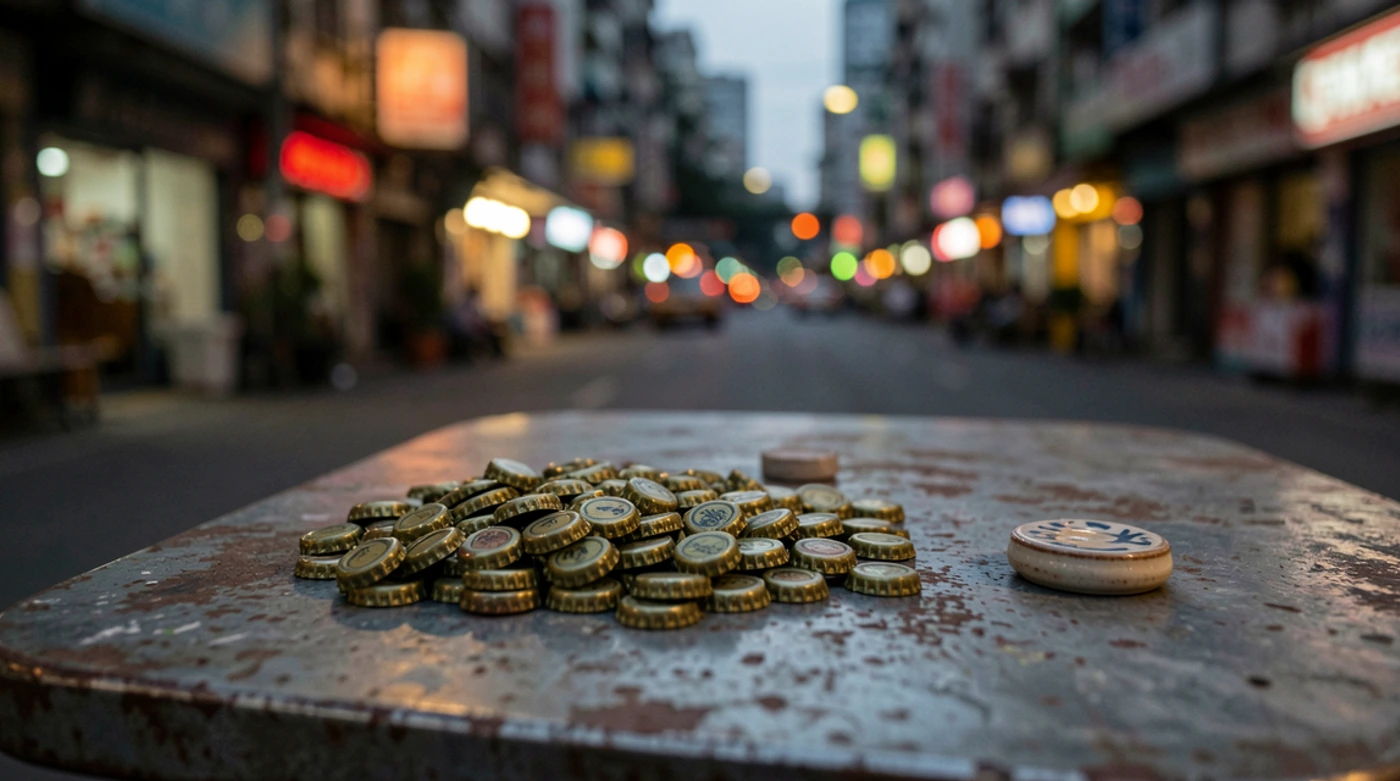
You're standing in the Zhongshan MRT station at rush hour, surrounded by a sea of Chinese characters on signs, advertisements, and passengers' phone screens. The overwhelming visual complexity feels impossible to decode—until you notice something remarkable. The same handful of characters keeps appearing everywhere: [Chinese phrase callout: "的" with pronunciation and translation aids.] , [Chinese phrase callout: "是" with pronunciation and translation aids.] , [Chinese phrase callout: "不" with pronunciation and translation aids.] , [Chinese phrase callout: "了" with pronunciation and translation aids.] . These aren't random coincidences. They represent the mathematical backbone that makes Mandarin, despite its intimidating reputation, surprisingly learnable.
Here's something that might transform your entire approach to Mandarin: studies of spoken Mandarin suggest that the most frequent 100 words may account for close to half of everyday conversation, while the top 500 words cover approximately three-quarters of daily speech.
While Zipf's law doesn't apply as strictly to Chinese as to alphabetic languages due to the nature of character-based writing, frequency patterns still show that a small set of common characters dominates everyday use. The characters that seemed impossibly complex from a distance reveal themselves as a small, manageable set of building blocks that native speakers use to construct virtually any idea.
This mathematical insight transforms everything about how you should approach Mandarin learning. What if fluency wasn't about memorizing thousands of characters, but mastering how a small set of essential patterns combine and recombine in endless, meaningful ways?
The Mathematics of Language Efficiency
Every language follows what linguists call a Zipfian distribution—a power law where a small number of words dominate usage frequency. In English, words like "the," "of," "and," and "to" appear everywhere, functioning as the structural glue that holds sentences together. Mandarin operates on this same principle, but with even greater efficiency.
Consider the workhorses of Mandarin conversation: [Chinese phrase callout: "的" with pronunciation and translation aids.] , [Chinese phrase callout: "是" with pronunciation and translation aids.] , [Chinese phrase callout: "不" with pronunciation and translation aids.] , [Chinese phrase callout: "了" with pronunciation and translation aids.] , and [Chinese phrase callout: "在" with pronunciation and translation aids.] . These five words alone appear in virtually every extended conversation, serving grammatical functions that English spreads across dozens of different constructions.
The word
[Chinese phrase callout: "的" with pronunciation and translation aids.] appears so frequently that mastering its various uses—possession, modification, nominalization—gives you immediate access to sophisticated expression patterns that native speakers use unconsciously.
This mathematical reality exposes a fundamental flaw in traditional language instruction approaches. While textbooks organize vocabulary thematically-family words one week, food words the next-frequency-first learning targets the language where it actually operates: in the recurring patterns that native speakers use thousands of times each day.
The character-based writing system that intimidates beginners actually amplifies this efficiency advantage. Unlike alphabetic languages where each word must be learned independently, Mandarin's compositional nature means the same core characters from your first 500 words become building blocks for thousands of compound expressions. When you learn [Chinese phrase callout: "学" with pronunciation and translation aids.] and [Chinese phrase callout: "校" with pronunciation and translation aids.] , you automatically unlock [Chinese phrase callout: "学校" with pronunciation and translation aids.] . Master [Chinese phrase callout: "电" with pronunciation and translation aids.] and [Chinese phrase callout: "话" with pronunciation and translation aids.] , and [Chinese phrase callout: "电话" with pronunciation and translation aids.] becomes immediately intuitive.
This compositional power means that 500 base characters generate exponentially more meaning than 500 isolated vocabulary items could ever provide.
Why Mandarin Is Actually Easier Than Advertised
Traditional approaches to Mandarin instruction often emphasize the language's challenges—tones, characters, cultural context—while overlooking its remarkable structural efficiency. Unlike English, which requires learners to master irregular verb conjugations, gender agreements, and complex pluralization rules, Mandarin operates on transparent principles that reward pattern recognition over memorization.
Verbs don't conjugate for person, number, or tense. Time relationships emerge through context and specific time markers rather than morphological changes.
[Chinese phrase callout: "我吃" with pronunciation and translation aids.] becomes [Chinese phrase callout: "我昨天吃" with pronunciation and translation aids.] simply by adding a time word, not by transforming the verb itself. This consistency means that once you understand basic sentence patterns, you can express complex ideas without navigating the grammatical transformations that make other languages challenging for adults.
The most frequent words in Mandarin tend to be grammatical particles and function words that appear across every topic and register. Unlike English, where high-frequency words like "good," "make," and "way" require understanding multiple meanings and idiomatic uses, Mandarin's most common words typically serve clear, consistent functions. [Chinese phrase callout: "了" with pronunciation and translation aids.] , [Chinese phrase callout: "吗" with pronunciation and translation aids.] , [Chinese phrase callout: "很" with pronunciation and translation aids.] . These patterns remain stable whether you're discussing philosophy or ordering coffee.
The Taiwanese Mandarin Advantage
In Taiwan, colloquial Mandarin leans even more heavily on core vocabulary than formal registers might suggest. Taiwanese speakers often prefer gentler constructions and indirect expressions that rely heavily on a smaller set of versatile words. Where mainland Mandarin might use [Chinese phrase callout: "能够" with pronunciation and translation aids.] , Taiwanese Mandarin more commonly uses [Chinese phrase callout: "可以" with pronunciation and translation aids.] or [Chinese phrase callout: "會" with pronunciation and translation aids.] —both of which appear in the top frequency lists.
This preference for familiar patterns extends beyond individual word choice to entire conversational structures. Consider this typical exchange from a bustling Taipei café:
Customer approaches counter
[Chinese phrase callout: "你好,你要喝什麼?" with pronunciation and translation aids.]
[Chinese phrase callout: "我要一杯咖啡,謝謝。" with pronunciation and translation aids.]
[Chinese phrase callout: "好的,你要加什麼嗎?" with pronunciation and translation aids.]
[Chinese phrase callout: "不用了,謝謝。" with pronunciation and translation aids.]
Breaking down this simple interaction reveals how dramatically the frequency distribution skews toward common words: [Chinese phrase callout: "你" with pronunciation and translation aids.] , [Chinese phrase callout: "要" with pronunciation and translation aids.] , [Chinese phrase callout: "什麼" with pronunciation and translation aids.] , [Chinese phrase callout: "我" with pronunciation and translation aids.] , [Chinese phrase callout: "了" with pronunciation and translation aids.] , [Chinese phrase callout: "嗎" with pronunciation and translation aids.] , [Chinese phrase callout: "不" with pronunciation and translation aids.] , [Chinese phrase callout: "好" with pronunciation and translation aids.] , [Chinese phrase callout: "的" with pronunciation and translation aids.] , and [Chinese phrase callout: "謝謝" with pronunciation and translation aids.] comprise the structural backbone, while only a few content words— [Chinese phrase callout: "咖啡" with pronunciation and translation aids.] , [Chinese phrase callout: "杯" with pronunciation and translation aids.] , [Chinese phrase callout: "加" with pronunciation and translation aids.] —carry the specific semantic load.
Street-level Mandarin, the language of daily life in Taiwan's cities, becomes even more repetitive and formulaic than formal registers.
Common expressions like [Chinese phrase callout: "沒關係" with pronunciation and translation aids.] , [Chinese phrase callout: "不好意思" with pronunciation and translation aids.] , and [Chinese phrase callout: "怎麼了" with pronunciation and translation aids.] appear with such frequency that mastering just twenty such phrases provides social scaffolding for countless interactions.
Strategic Learning Through Frequency Data
Understanding frequency distribution transforms how intelligent learners approach vocabulary acquisition. Rather than following arbitrary textbook progressions or attempting to learn characters in stroke-order sequences, frequency-first learning focuses energy where it generates maximum communicative return.
The strategic approach begins with the top 100 function words—particles, pronouns, basic verbs, and structural elements that appear in virtually every sentence.
These words provide the grammatical framework that makes Mandarin sentences comprehensible, even when content vocabulary remains unfamiliar. A learner who masters [Chinese phrase callout: "的" with pronunciation and translation aids.] , [Chinese phrase callout: "是" with pronunciation and translation aids.] , [Chinese phrase callout: "不" with pronunciation and translation aids.] , [Chinese phrase callout: "了" with pronunciation and translation aids.] , [Chinese phrase callout: "在" with pronunciation and translation aids.] , [Chinese phrase callout: "有" with pronunciation and translation aids.] , [Chinese phrase callout: "我" with pronunciation and translation aids.] , [Chinese phrase callout: "你" with pronunciation and translation aids.] , [Chinese phrase callout: "他" with pronunciation and translation aids.] , and [Chinese phrase callout: "她" with pronunciation and translation aids.] can begin to parse the structure of almost any sentence, even if specific content words remain unclear.
Building from this foundation, the next 400 words focus on high-frequency content vocabulary that spans domains and registers. These include basic actions ( [Chinese phrase callout: "去" with pronunciation and translation aids.] , [Chinese phrase callout: "来" with pronunciation and translation aids.] , [Chinese phrase callout: "看" with pronunciation and translation aids.] , [Chinese phrase callout: "说" with pronunciation and translation aids.] ), essential descriptors ( [Chinese phrase callout: "大" with pronunciation and translation aids.] , [Chinese phrase callout: "小" with pronunciation and translation aids.] , [Chinese phrase callout: "好" with pronunciation and translation aids.] , [Chinese phrase callout: "多" with pronunciation and translation aids.] ), and universal concepts ( [Chinese phrase callout: "时间" with pronunciation and translation aids.] , [Chinese phrase callout: "地方" with pronunciation and translation aids.] , [Chinese phrase callout: "东西" with pronunciation and translation aids.] , [Chinese phrase callout: "朋友" with pronunciation and translation aids.] ).
This systematic approach leverages what psychologists call the "generation effect"-information we actively process and connect to existing knowledge sticks better than information we passively encounter. By learning words in frequency order, each new word immediately connects to dozens of previously learned words in natural sentence patterns, creating rich associative networks that support both comprehension and production.
The most effective learners supplement frequency-based vocabulary study with comprehensible input that naturally exposes them to these high-frequency patterns in context.
Taiwanese variety shows provide particularly valuable exposure because they feature informal conversation patterns, emotional expressions, and cultural references that textbooks typically avoid but that dominate actual social interaction.
Understanding why this approach works so powerfully requires examining how your brain actually processes language learning. Modern cognitive science reveals that every time you encounter a high-frequency word in context, your brain strengthens both the word's individual representation and its connections to other words that commonly appear nearby. This creates what researchers call "distributional learning"—understanding that emerges not from explicit instruction but from statistical regularities in the linguistic environment.
The neurological process mirrors pattern recognition in other domains. Just as musicians develop intuition for chord progressions through repeated exposure to common sequences, language learners develop grammatical intuition through repeated exposure to high-frequency word combinations. The crucial difference is that language frequency patterns are far more concentrated than musical patterns-a few dozen word combinations account for enormous proportions of everyday expression.
This explains why traditional approaches that spread attention evenly across vocabulary domains consistently fail to generate fluency. The brain learns what it encounters most frequently, not what textbooks present as thematically coherent units. By aligning study priorities with actual usage patterns, frequency-first learning works with neural learning mechanisms rather than fighting against them.
The Psychology of Progress and Motivation
Beyond the neurological advantages, frequency-first learning transforms the psychological experience of language acquisition in ways that dramatically improve motivation and persistence. Traditional metrics—characters learned, textbook chapters completed, vocabulary lists memorized—often create discouragement because they don't correspond to actual communicative capability.
Understanding frequency distribution allows you to reinterpret your knowledge more accurately. Instead of thinking "I only know 300 words," a frequency-aware learner might recognize "I can understand a significant portion of typical conversation."
This reframing reflects the mathematical reality of how language actually works and provides more accurate feedback about practical progress.
This reframing has profound implications for motivation and persistence. A learner who understands that mastering just five words— [Chinese phrase callout: "是" with pronunciation and translation aids.] , [Chinese phrase callout: "的" with pronunciation and translation aids.] , [Chinese phrase callout: "不" with pronunciation and translation aids.] , [Chinese phrase callout: "了" with pronunciation and translation aids.] , and [Chinese phrase callout: "在" with pronunciation and translation aids.] —provides access to structural patterns that appear in virtually every sentence experiences immediate, tangible progress. Each new high-frequency word unlocks disproportionate understanding through multiplicative combinations with previously learned vocabulary.
The mathematical approach also establishes realistic expectations about the learning curve. Achieving 25% comprehension might require just 50 words, reaching 50% might require 200 words, while approaching 75% demands the full 500 words. This diminishing returns pattern reflects Zipfian distributions and explains why early progress feels rapid while later gains require sustained effort.
Practical Implementation Strategies
Strategic implementation requires tools that prioritize high-frequency items while maintaining contextual richness. Spaced repetition systems like Anki can be configured with frequency-based decks that present the most common words first, ensuring study time generates maximum communicative return.
Isolated vocabulary study must be complemented by contextual exposure demonstrating how these patterns function in natural speech. Taiwanese variety shows provide particularly valuable exposure—featuring informal conversation patterns, emotional expressions, and cultural references that textbooks avoid but that dominate actual social interaction.
Successful learners develop "frequency awareness"—recognizing high-value linguistic patterns worth special attention.
This means pausing when familiar words appear in new combinations, noting how [Chinese phrase callout: "會" with pronunciation and translation aids.] can express future possibility, past habit, or learned ability depending on context, and collecting examples of how [Chinese phrase callout: "就" with pronunciation and translation aids.] creates emphasis, timing, and logical connections across sentence types.
Advanced learners extend this approach to character-level frequency, prioritizing the 500-1000 most common characters that appear across multiple expressions. This pays enormous dividends because Chinese characters function both as semantic units and as components in compound words. Learning [Chinese phrase callout: "工" with pronunciation and translation aids.] immediately unlocks [Chinese phrase callout: "工作" with pronunciation and translation aids.] , [Chinese phrase callout: "工人" with pronunciation and translation aids.] , [Chinese phrase callout: "工程" with pronunciation and translation aids.] , and dozens of other essential expressions.
Your Starting Point: The Top 100 Most Common Mandarin Characters
The following table presents the 100 most frequently occurring characters in Mandarin Chinese, based on Jun Da's Modern Chinese Character Frequency List from MTSU (https://lingua.mtsu.edu/chinese-computing/statistics/char/list.php?Which=MO). These characters form the foundation of everyday communication and represent your most efficient starting point for reading and understanding Mandarin.
| Rank | Character | Zhuyin | Pinyin | English | Frequency% |
|---|---|---|---|---|---|
| 1 | 的 | ㄉㄜ˙ | de | (possessive particle)/of | 4.09% |
| 2 | 一 | ㄧ | yī | one | 1.58% |
| 3 | 是 | ㄕˋ | shì | to be | 1.35% |
| 4 | 不 | ㄅㄨˋ | bù | not/no | 1.16% |
| 5 | 了 | ㄌㄜ˙ | le | (completed action) | 1.10% |
| 6 | 在 | ㄗㄞˋ | zài | at/in/exist | 1.04% |
| 7 | 人 | ㄖㄣˊ | rén | person/people | 0.96% |
| 8 | 有 | ㄧㄡˇ | yǒu | to have/there is | 0.92% |
| 9 | 我 | ㄨㄛˇ | wǒ | I/me | 0.87% |
| 10 | 他 | ㄊㄚ | tā | he/him | 0.82% |
| 11 | 這 | ㄓㄜˋ | zhè | this | 0.80% |
| 12 | 個 | ㄍㄜˋ | gè | (measure word) | 0.62% |
| 13 | 們 | ㄇㄣ˙ | men | (plural marker) | 0.60% |
| 14 | 中 | ㄓㄨㄥ | zhōng | middle/center/China | 0.57% |
| 15 | 來 | ㄌㄞˊ | lái | to come | 0.56% |
| 16 | 上 | ㄕㄤˋ | shàng | on/above/up | 0.55% |
| 17 | 大 | ㄉㄚˋ | dà | big/large | 0.54% |
| 18 | 為 | ㄨㄟˋ | wèi | to be/for | 0.54% |
| 19 | 和 | ㄏㄜˊ | hé | and/with | 0.52% |
| 20 | 國 | ㄍㄨㄛˊ | guó | country/nation | 0.51% |
| 21 | 地 | ㄉㄧˋ | dì | earth/ground/place | 0.50% |
| 22 | 到 | ㄉㄠˋ | dào | to/until/arrive | 0.50% |
| 23 | 以 | ㄧˇ | yǐ | to use/by | 0.47% |
| 24 | 說 | ㄕㄨㄛ | shuō | to say/speak | 0.45% |
| 25 | 時 | ㄕˊ | shí | time/hour | 0.43% |
| 26 | 要 | ㄧㄠˋ | yào | to want/must | 0.42% |
| 27 | 就 | ㄐㄧㄡˋ | jiù | then/right away | 0.40% |
| 28 | 出 | ㄔㄨ | chū | to go out/to come out | 0.39% |
| 29 | 會 | ㄏㄨㄟˋ | huì | can/will/meeting | 0.38% |
| 30 | 可 | ㄎㄜˇ | kě | can/may | 0.37% |
| 31 | 也 | ㄧㄝˇ | yě | also/too | 0.37% |
| 32 | 你 | ㄋㄧˇ | nǐ | you | 0.36% |
| 33 | 對 | ㄉㄨㄟˋ | duì | correct/to face | 0.36% |
| 34 | 生 | ㄕㄥ | shēng | to be born/life | 0.35% |
| 35 | 能 | ㄋㄥˊ | néng | can/able | 0.34% |
| 36 | 而 | ㄦˊ | ér | and/yet | 0.34% |
| 37 | 子 | ㄗˇ | zǐ | child/son | 0.33% |
| 38 | 那 | ㄋㄚˋ | nà | that | 0.33% |
| 39 | 得 | ㄉㄜˊ | dé | to get/obtain | 0.33% |
| 40 | 於 | ㄩˊ | yú | in/at/to | 0.33% |
| 41 | 著 | ㄓㄜ˙ | zhe | (progressive aspect) | 0.32% |
| 42 | 下 | ㄒㄧㄚˋ | xià | under/below/down | 0.32% |
| 43 | 自 | ㄗˋ | zì | self/from | 0.31% |
| 44 | 之 | ㄓ | zhī | (possessive particle) | 0.31% |
| 45 | 年 | ㄋㄧㄢˊ | nián | year | 0.31% |
| 46 | 過 | ㄍㄨㄛˋ | guò | to pass/cross | 0.30% |
| 47 | 發 | ㄈㄚ | fā | to send/develop | 0.30% |
| 48 | 後 | ㄏㄡˋ | hòu | after/behind | 0.30% |
| 49 | 作 | ㄗㄨㄛˋ | zuò | to do/to make | 0.28% |
| 50 | 裡 | ㄌㄧˇ | lǐ | inside/interior | 0.28% |
| 51 | 用 | ㄩㄥˋ | yòng | to use | 0.28% |
| 52 | 道 | ㄉㄠˋ | dào | way/road/method | 0.27% |
| 53 | 行 | ㄒㄧㄥˊ | xíng | to go/to do | 0.27% |
| 54 | 所 | ㄙㄨㄛˇ | suǒ | place/actually | 0.27% |
| 55 | 然 | ㄖㄢˊ | rán | correct/so/thus | 0.26% |
| 56 | 家 | ㄐㄧㄚ | jiā | home/family | 0.26% |
| 57 | 種 | ㄓㄨㄥˇ | zhǒng | kind/type/seed | 0.26% |
| 58 | 事 | ㄕˋ | shì | matter/thing | 0.26% |
| 59 | 成 | ㄔㄥˊ | chéng | to become/to complete | 0.26% |
| 60 | 方 | ㄈㄤ | fāng | square/direction | 0.25% |
| 61 | 多 | ㄉㄨㄛ | duō | many/much | 0.25% |
| 62 | 經 | ㄐㄧㄥ | jīng | to pass through | 0.25% |
| 63 | 麼 | ㄇㄜ˙ | me | (interrog. particle) | 0.25% |
| 64 | 去 | ㄑㄩˋ | qù | to go | 0.25% |
| 65 | 法 | ㄈㄚˇ | fǎ | law/method | 0.24% |
| 66 | 學 | ㄒㄩㄝˊ | xué | to study/learn | 0.24% |
| 67 | 如 | ㄖㄨˊ | rú | like/as if | 0.23% |
| 68 | 都 | ㄉㄡ | dōu | all/both | 0.23% |
| 69 | 同 | ㄊㄨㄥˊ | tóng | same/together | 0.23% |
| 70 | 現 | ㄒㄧㄢˋ | xiàn | present/current | 0.22% |
| 71 | 當 | ㄉㄤ | dāng | to be/should | 0.22% |
| 72 | 沒 | ㄇㄟˊ | méi | not have/did not | 0.22% |
| 73 | 動 | ㄉㄨㄥˋ | dòng | to move/to act | 0.22% |
| 74 | 面 | ㄇㄧㄢˋ | miàn | face/side/surface | 0.22% |
| 75 | 起 | ㄑㄧˇ | qǐ | to rise/to raise | 0.22% |
| 76 | 看 | ㄎㄢˋ | kàn | to see/to look | 0.22% |
| 77 | 定 | ㄉㄧㄥˋ | dìng | to fix/to determine | 0.22% |
| 78 | 天 | ㄊㄧㄢ | tiān | day/sky/heaven | 0.22% |
| 79 | 分 | ㄈㄣ | fēn | to divide/minute | 0.22% |
| 80 | 還 | ㄏㄞˊ | hái | still/also/yet | 0.21% |
| 81 | 進 | ㄐㄧㄣˋ | jìn | to advance/enter | 0.21% |
| 82 | 好 | ㄏㄠˇ | hǎo | good/well | 0.21% |
| 83 | 小 | ㄒㄧㄠˇ | xiǎo | small/little | 0.21% |
| 84 | 部 | ㄅㄨˋ | bù | part/section | 0.21% |
| 85 | 其 | ㄑㄧˊ | qí | his/her/its | 0.21% |
| 86 | 些 | ㄒㄧㄝ | xiē | some/few | 0.21% |
| 87 | 主 | ㄓㄨˇ | zhǔ | main/master | 0.21% |
| 88 | 樣 | ㄧㄤˋ | yàng | manner/appearance | 0.21% |
| 89 | 理 | ㄌㄧˇ | lǐ | reason/logic | 0.20% |
| 90 | 心 | ㄒㄧㄣ | xīn | heart/mind | 0.20% |
| 91 | 她 | ㄊㄚ | tā | she | 0.20% |
| 92 | 本 | ㄅㄣˇ | běn | root/origin/this | 0.20% |
| 93 | 前 | ㄑㄧㄢˊ | qián | before/front | 0.20% |
| 94 | 開 | ㄎㄞ | kāi | to open/to start | 0.19% |
| 95 | 但 | ㄉㄢˋ | dàn | but/yet | 0.19% |
| 96 | 因 | ㄧㄣ | yīn | cause/because | 0.19% |
| 97 | 隻 | ㄓ | zhī | (measure word) | 0.19% |
| 98 | 從 | ㄘㄨㄥˊ | cóng | from/to follow | 0.19% |
| 99 | 想 | ㄒㄧㄤˇ | xiǎng | to think/to want | 0.19% |
| 100 | 實 | ㄕˊ | shí | real/true/honest | 0.19% |
Note: Frequency data sourced from Jun Da's Modern Chinese Character Frequency List (2004). Percentages indicate the proportion of total character occurrences in the corpus. Traditional character forms are used throughout for Taiwan standard compliance.
The Compression of Understanding
From Understanding to Mastery: Your Frequency-First Journey
The deepest insight connects to how human cognition processes language. Fluency isn't about unlimited vocabulary access—it's about developing unconscious facility with patterns that carry most communicative load. Native speakers aren't walking dictionaries; they're experts at leveraging a modest set of highly flexible linguistic tools.
This transforms how you understand the relationship between learning and mastery. Mandarin fluency emerges not from accumulating vast linguistic knowledge but from achieving effortless command of core patterns that native speakers use to construct meaning.
The most articulate speakers aren't those with the largest vocabularies—they're those who manipulate basic elements with greatest precision and creativity. This explains why some learners achieve impressive communicative competence with modest vocabulary knowledge, while others remain stilted despite extensive study. The difference lies not in quantity but in deployment fluency. Frequency-first learning optimizes for exactly this practical facility.
The mathematical beauty of Zipfian distributions reveals something profound about human communication: we've evolved linguistic systems that maximize expression while minimizing cognitive load. The same small set of patterns that carries most meaning also represents the most efficient path to practical competence. This isn't a limitation of language—it's evidence of its elegant design.
The statistical reality we explored at the beginning—that 500 words unlock 75% of daily conversation—isn't just a learning efficiency hack. It reveals something fundamental about human communication itself.
Learning Mandarin through frequency awareness means recognizing that you don't need to master everything in the language. You just need to understand what everyone actually says, most of the time. That insight transforms an overwhelming challenge into an achievable goal.
Your next step is straightforward: Start with the top 100 function words that appear in virtually every Mandarin sentence. Build your foundation with [Chinese phrase callout: "的" with pronunciation and translation aids.] , [Chinese phrase callout: "是" with pronunciation and translation aids.] , [Chinese phrase callout: "不" with pronunciation and translation aids.] , [Chinese phrase callout: "了" with pronunciation and translation aids.] , and [Chinese phrase callout: "在" with pronunciation and translation aids.] . Add the high-frequency content vocabulary that spans every conversation. The path to practical Mandarin fluency isn't paved with years of character memorization or complex cultural immersion—it's built from the 500 words that real Taiwanese people use to navigate their daily lives, combined and recombined in patterns that become second nature through focused practice and authentic exposure.
Master those patterns, and you've mastered the language where it genuinely matters.