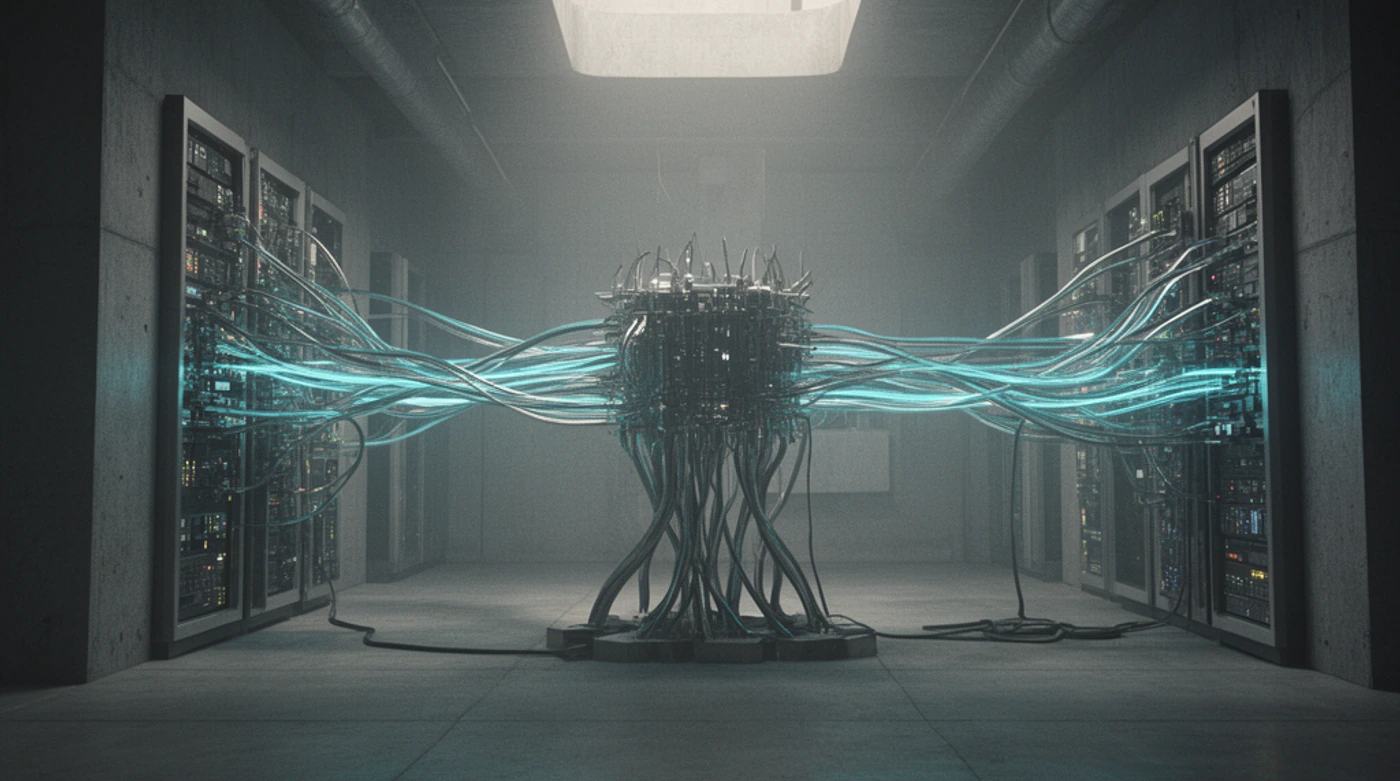
Two AI systems process the same 100,000-word document. The first system, using traditional Multi-Head Attention, requires 64GB of memory and takes twelve minutes to generate a response. The second system, employing Grouped Query Attention, uses just 16GB of memory and completes the same task in under three minutes. Both produce responses of comparable quality, yet one achieves this efficiency through a deceptively simple architectural change that has quietly revolutionized how modern AI systems handle long contexts.
This isn't a hypothetical comparison. Throughout 2025, Grouped Query Attention has emerged as the dominant attention mechanism powering the most capable language models in production. From Llama 3.1's groundbreaking 128,000-token context window to GPT-4o's efficient processing of complex multi-modal inputs, GQA has become the engineering innovation that makes today's long-context capabilities both practical and economically viable.
Understanding GQA reveals how subtle architectural modifications can unlock dramatic improvements in AI system performance. The mechanism represents a masterful balance between computational efficiency and model capability, demonstrating that the most impactful advances in AI often come not from adding complexity, but from intelligently reducing it in precisely the right places.
The Memory Challenge in Modern Transformers
Before exploring how GQA solves the scaling problem, we need to understand why traditional attention mechanisms struggle with long contexts. The challenge lies in how Multi-Head Attention (MHA) manages the key-value pairs that enable transformers to understand relationships between different parts of the input sequence.
In traditional MHA, each attention head maintains its own complete set of key and value projections. When processing a sequence of 100,000 tokens with 32 attention heads, the model must store and manipulate 32 separate key matrices and 32 separate value matrices. As context length increases, memory requirements grow quadratically, creating a bottleneck that makes long-context processing prohibitively expensive.
Consider the practical implications for a model like GPT-4 processing a full-length novel. Traditional attention would require storing approximately 2.1 billion key-value pairs in memory simultaneously, demanding resources that push even advanced hardware to its limits. This memory pressure doesn't just slow processing; it fundamentally constrains the types of tasks these models can handle in real-world applications.
The problem becomes even more acute during inference, when models must maintain these key-value caches for interactive applications. A chatbot conversation that spans several hours of back-and-forth exchanges quickly accumulates enough context to overwhelm traditional attention mechanisms, forcing developers to implement crude truncation strategies that sacrifice the very long-term coherence that makes AI assistants most valuable.
The Elegant Solution: Sharing Keys and Values
Grouped Query Attention addresses this challenge through a surprisingly straightforward insight: not every attention head needs its own unique key and value projections. Instead of maintaining separate key-value pairs for each head, GQA groups multiple query heads to share the same key and value projections, dramatically reducing memory requirements while preserving most of the model's representational power.
Think of this like a research library system. In traditional MHA, every researcher (attention head) brings their own complete reference collection to the library. In GQA, researchers still bring their own specific questions and research interests (queries), but they share access to a smaller number of comprehensive reference collections (key-value pairs). The researchers can still conduct sophisticated analysis, but the library requires far less storage space and operates much more efficiently.
The mathematical elegance lies in selective parameter reduction. While query projections remain numerous to preserve the model's ability to ask diverse questions about the input, key and value projections are consolidated into groups. A typical GQA configuration might use 32 query heads sharing just 8 key-value groups, reducing memory requirements by approximately 75% while maintaining 85-95% of the original model's performance.
This sharing strategy works because keys and values often capture similar patterns across different attention heads. Research has shown that many attention heads in large models develop redundant representations, focusing on similar linguistic patterns or semantic relationships. GQA exploits this redundancy, eliminating unnecessary duplication while preserving the essential diversity needed for complex language understanding.
Real-World Impact: The 2025 Model Revolution
The practical impact of GQA becomes clear when examining the flagship models released throughout 2025. Llama 3.1, with its unprecedented 128,000-token context window, relies heavily on GQA to make such long contexts computationally feasible. Without this efficiency gain, processing contexts of this length would require prohibitively expensive hardware configurations that would limit the model's accessibility and practical deployment.
GPT-4o demonstrates another dimension of GQA's value in multi-modal applications. When processing combinations of text, images, and audio, the model must maintain attention across diverse input types simultaneously. GQA's memory efficiency enables the model to handle these complex multi-modal contexts without sacrificing the responsiveness that users expect from interactive AI systems.
Claude 3.5 showcases how GQA enables more sophisticated reasoning over long documents. The model can maintain coherent analysis across entire research papers, legal documents, or technical specifications without the memory constraints that would force traditional attention mechanisms to lose track of earlier context. This capability has transformed how professionals use AI for document analysis and complex reasoning tasks.
These benefits extend beyond individual model performance to broader deployment considerations. Data centers running GQA-based models can serve more concurrent users with the same hardware, reducing operational costs and improving accessibility. This economic advantage has accelerated the adoption of long-context AI applications across industries, from legal document review to scientific literature analysis.
The Architecture in Practice
Understanding how GQA works in practice requires examining the specific architectural choices that make it effective. Modern implementations typically organize attention heads into groups of 4-8 queries sharing each key-value pair, though the optimal grouping depends on model size and target applications. Larger models can often use more aggressive grouping ratios, while smaller models may require more conservative approaches to maintain performance.
The grouping strategy itself has evolved throughout 2025, with researchers discovering that different layers benefit from different grouping configurations. Early layers, which typically focus on basic linguistic patterns, can often use more aggressive key-value sharing. Deeper layers, responsible for complex reasoning and semantic understanding, may require more diverse key-value representations to maintain their sophisticated capabilities.
Training GQA models requires careful attention to initialization and learning rate schedules. The shared key-value projections must learn to serve multiple query heads effectively, demanding training procedures that encourage these shared representations to capture essential patterns from the original multi-head configuration. Advanced training techniques, including knowledge distillation from full MHA models, have proven particularly effective for achieving optimal performance.
Implementation details matter significantly for real-world performance. Efficient GQA implementations carefully manage memory layout to maximize cache efficiency, group computations to leverage modern GPU architectures, and implement specialized kernels that exploit sharing patterns to achieve maximum throughput. These optimizations determine whether theoretical gains translate into practical deployment advantages.
Beyond Efficiency: Quality and Capability Preservation
One of the most remarkable aspects of GQA is how effectively it preserves model quality while dramatically improving efficiency. Extensive evaluations across diverse benchmarks consistently show that well-implemented GQA models retain 85-95% of their full MHA counterparts' performance while using significantly less memory and computation.
This quality preservation stems from GQA's selective parameter reduction strategy. By maintaining the full diversity of query projections while consolidating keys and values, the mechanism preserves the model's ability to ask sophisticated questions about the input while streamlining the information retrieval process. The queries can still capture nuanced patterns and relationships; they simply access a more efficiently organized knowledge base.
The performance characteristics vary across different types of tasks, with some applications actually benefiting from GQA's consolidation effects. Tasks requiring consistent attention patterns across long sequences often perform better with shared key-value representations, as the consolidation reduces noise and focuses attention on the most relevant patterns. Complex reasoning tasks that benefit from diverse perspectives may show slight performance decreases, though these are typically offset by the ability to process much longer contexts.
Recent research has revealed that GQA models often develop more robust attention patterns than their MHA counterparts. The constraint of shared key-value representations appears to encourage the development of more generalizable attention mechanisms that transfer better across different types of inputs and tasks. This robustness has made GQA models particularly attractive for applications requiring consistent performance across diverse use cases.
The Evolution Toward Multi-Head Latent Attention
While GQA represents a significant advancement in attention efficiency, the field continues to evolve toward even more sophisticated approaches. Multi-Head Latent Attention (MLA), emerging as the next generation of attention mechanisms, builds on GQA's insights while introducing additional innovations for extreme-scale applications.
MLA extends GQA's sharing concept by introducing latent representations that capture attention patterns across multiple heads simultaneously. Rather than simply sharing key-value pairs, MLA learns compressed latent representations that can be efficiently expanded to serve multiple attention heads. This approach promises even greater memory efficiency while potentially improving model quality through more sophisticated representation learning.
The transition from GQA to MLA reflects the ongoing evolution of attention mechanisms toward greater efficiency and capability. Each generation builds on the insights of its predecessors, finding new ways to balance computational constraints with model performance. GQA's success in production systems provides the foundation for these next-generation approaches, demonstrating that efficiency innovations can enhance rather than compromise model capabilities.
DeepSeek's recent architectural innovations exemplify this evolutionary trajectory, combining GQA principles with novel training techniques and architectural modifications that push the boundaries of what's possible with efficient attention mechanisms. These developments suggest that the attention mechanism landscape will continue evolving rapidly, with each innovation building on the practical lessons learned from GQA deployment.
Implications for AI Development and Deployment
The widespread adoption of GQA throughout 2025 has implications that extend far beyond technical architecture choices. By making long-context processing economically viable, GQA has enabled entirely new categories of AI applications that were previously impractical due to computational constraints.
Document analysis applications can now process entire legal contracts, research papers, or technical manuals without truncation or summarization, enabling more accurate and comprehensive analysis. Educational applications can maintain context across entire textbooks or course materials, providing more coherent and contextually aware tutoring experiences. Creative applications can work with full-length novels or screenplays, maintaining narrative coherence and character consistency across extended works.
The economic implications are equally significant. Organizations can deploy sophisticated AI capabilities with more modest hardware requirements, democratizing access to advanced technologies. Cloud providers can serve more customers with the same infrastructure, reducing costs and improving accessibility. These gains have accelerated AI adoption across industries and use cases that were previously cost-prohibitive.
From a research perspective, GQA has demonstrated the value of architectural innovations that complement rather than compete with scaling laws. While the field continues to develop larger models with more parameters, GQA shows that intelligent architectural choices can achieve dramatic improvements in practical performance without simply adding more computation.
The Quiet Revolution in AI Architecture
Grouped Query Attention represents one of those rare innovations that fundamentally changes how an entire field operates while remaining largely invisible to end users. The technique has quietly revolutionized transformer architecture, enabling the long-context capabilities that define modern AI systems while maintaining the efficiency needed for practical deployment.
The success of GQA demonstrates that the most impactful advances in AI often come from understanding and optimizing existing mechanisms rather than inventing entirely new approaches. By carefully analyzing how attention mechanisms actually work in practice, researchers identified opportunities for dramatic efficiency improvements that preserve the essential capabilities while eliminating unnecessary computational overhead.
As we look toward the future of AI development, GQA's influence extends beyond its immediate technical contributions. The approach exemplifies a mature engineering perspective that balances theoretical capability with practical constraints, showing how sophisticated AI systems can be made more accessible and deployable without sacrificing their essential capabilities.
What strikes me most about GQA's journey is how it represents a shift in how we think about AI progress. Instead of always reaching for bigger and more complex solutions, we're learning to work smarter with what we have.
The next time you interact with an AI system that seamlessly handles long documents, maintains context across extended conversations, or processes complex multi-modal inputs, you're witnessing the quiet power of Grouped Query Attention at work. Just as our opening comparison showed two systems achieving dramatically different efficiency levels through architectural choice alone, GQA continues to demonstrate that the most transformative advances often come from understanding and optimizing what we already have, rather than building something entirely new.
Behind the scenes, this elegant architectural innovation is enabling the long-context AI capabilities that are transforming how we work, learn, and create in an increasingly AI-integrated world. And perhaps most importantly, it's doing so in a way that makes these powerful capabilities accessible to more people and organizations than ever before.