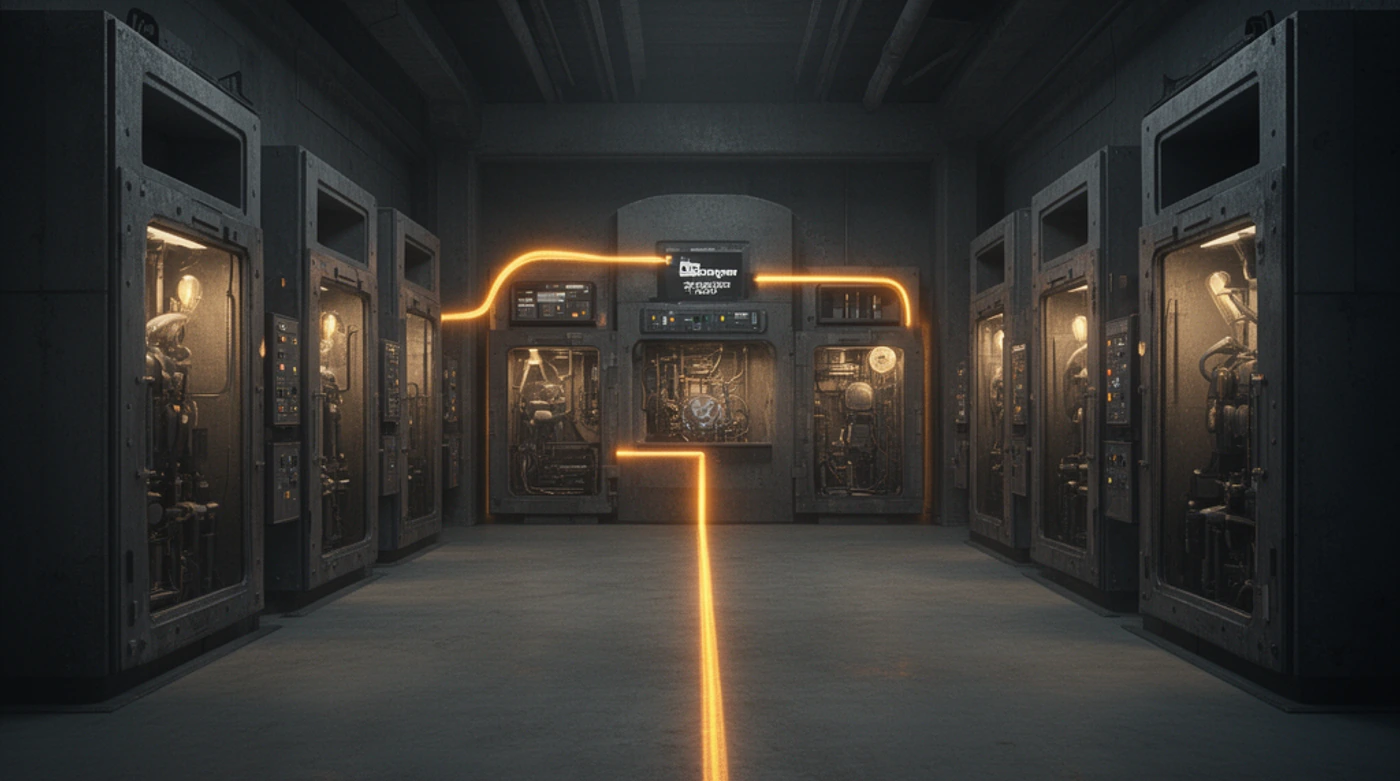
DeepSeek-R1 contains 671 billion parameters but uses only 37 billion during inference. That represents a 94.5% reduction in active computation while maintaining performance that rivals models requiring vastly more resources. This isn't a theoretical breakthrough or a laboratory curiosity - it's the production reality of 2025's most advanced AI systems, and it fundamentally changes how we think about scaling artificial intelligence.
When I first encountered these numbers, I had to double-check them. A 94% reduction seemed impossible - like claiming you could run a city by only powering 6% of its buildings. But that's exactly what's happening, and it's reshaping everything we thought we knew about AI scaling.
This dramatic efficiency gain comes from an architectural innovation called Mixture of Experts (MoE), which has quietly become the foundation for every major AI breakthrough of the past year. While the tech world debates whether we've hit scaling limits, MoE models like Llama 4 Behemoth are approaching two trillion total parameters while consuming compute budgets that would have been considered modest just two years ago.
The implications extend far beyond impressive statistics. MoE represents a fundamental shift from the "bigger is always better" mentality that dominated AI development to a more sophisticated approach that mirrors how human expertise actually works. Instead of activating every neuron for every task, these systems learn to route problems to specialized sub-networks that have developed deep competency in specific domains.
This transformation reflects a deeper understanding of intelligence itself. Just as a master craftsman doesn't use every tool for every task, these AI systems have learned the art of selective expertise - knowing not just what to compute, but when and where to apply their computational resources most effectively.
I think of it like a hospital emergency room. When a patient arrives, the triage nurse doesn't activate every specialist in the building. Instead, they quickly assess the situation and route the patient to exactly the right expert - the cardiologist for heart issues, the neurologist for brain concerns. MoE works the same way, but with millisecond decisions and thousands of routing choices per second.
The Traditional Transformer's Computational Bottleneck
To understand why MoE matters, we need to examine what happens inside a standard transformer when it processes text. Every token that flows through the model encounters the same computational pathway: multi-head attention followed by a feed-forward network (FFN). This FFN, despite its simple name, represents the computational heart of language understanding.
The feed-forward network takes the attention-processed representation of each token and passes it through a dense neural network that recognizes and transforms linguistic patterns. In GPT-4 scale models, this network contains billions of parameters, and every one activates for every token, regardless of whether that token is a simple article like "the" or a complex technical term requiring specialized knowledge.
This universal activation creates an elegant simplicity - the same computational pathway handles poetry, code, mathematical proofs, and casual conversation. But it also creates massive inefficiency. Processing the word "hello" requires the same computational resources as analyzing a complex chemical formula, even though these tasks demand vastly different types of knowledge and reasoning.
It's like having a team of world-class specialists - a poet, a programmer, a mathematician, and a linguist - all working on every single word that comes through the door. When someone asks "How's the weather?", you don't need the mathematician calculating differential equations or the programmer analyzing syntax trees. But in traditional transformers, that's exactly what happens.
The computational cost scales linearly with model size, creating what researchers call the "parameter wall." Doubling model capability traditionally required doubling parameters, which doubled memory requirements, inference costs, and energy consumption for training and deployment. This scaling relationship suggested that truly capable AI systems would eventually require computational resources beyond practical limits.
Enter the Mixture of Experts: Selective Intelligence
Mixture of Experts transforms this monolithic approach into something more akin to how human organizations actually function. Instead of one massive feed-forward network that handles everything, MoE models contain multiple specialized "expert" networks, each developing competency in different aspects of language and reasoning.
The breakthrough lies in the routing mechanism - a learned gating network that examines each token and decides which experts should process it. For a programming question, the router might activate experts specialized in code syntax and algorithmic thinking. For a creative writing prompt, different experts focused on narrative structure and linguistic creativity take the lead. Most remarkably, this routing happens dynamically and automatically, learned through the same training process that teaches the model language itself.
Watching this system work feels almost magical. The model develops its own internal sense of expertise without anyone explicitly teaching it which expert should handle what. It's like watching a jazz ensemble where musicians instinctively know when to step forward for a solo and when to provide backing support - except this ensemble has hundreds of members making thousands of coordination decisions every second.
This selective activation creates what researchers call "sparse computation" - the model's total capacity grows dramatically while the computational cost per token remains manageable. DeepSeek-R1's achievement of 94% parameter reduction demonstrates this principle at scale: the model has access to 671 billion parameters worth of knowledge and capability, but intelligently activates only the 37 billion most relevant to each specific task.
The routing decisions happen at incredible speed - thousands of times per second during inference - yet the overhead of this decision-making process adds minimal computational cost compared to the savings from selective activation. Modern implementations have reduced routing overhead to less than 2% of total computation, making the efficiency gains nearly pure benefit.
This elegant balance between decision-making and execution represents one of the most significant architectural breakthroughs in AI development. The system has learned to be simultaneously decisive and efficient, making thousands of routing choices without sacrificing the speed that makes real-time AI applications possible.
The first time I saw MoE routing decisions visualized in real-time, I was mesmerized. Imagine watching a city's traffic control system from above, but instead of cars, you're seeing thoughts and concepts flowing through neural pathways, each being directed to exactly the right destination with split-second precision. It's computational choreography at its finest.
The 2025 Breakthrough: Auxiliary-Loss-Free Load Balancing
One of the most significant technical advances in 2025 MoE systems addresses what researchers call the "load balancing problem." Early MoE implementations suffered from expert collapse - the routing network would learn to send most tokens to just a few experts, leaving others underutilized and creating computational bottlenecks.
Traditional solutions involved auxiliary loss functions that penalized uneven expert usage, but these created training instabilities and interfered with primary learning objectives. The breakthrough came from DeepSeek's research team, which developed auxiliary-loss-free load balancing that maintains expert utilization without compromising training dynamics.
This innovation enables much larger expert counts - Llama 4 Behemoth reportedly uses over 128 experts per layer, compared to the 8-16 experts in earlier systems. More experts mean finer-grained specialization, translating to better performance with the same computational budget. The system develops experts for highly specific domains: medical terminology, legal reasoning, different programming languages, or mathematical subdisciplines.
I find it fascinating how these experts naturally emerge during training. Nobody programs an expert to become the "Python specialist" or the "medical terminology expert." Instead, through millions of training examples, certain experts gravitate toward specific types of knowledge, like students naturally finding their academic strengths. The system organically develops its own internal university, complete with specialized departments.
The load balancing breakthrough also enables what researchers call "expert evolution" during training. Instead of fixing expert roles early in training, the system can dynamically reallocate specializations as it encounters different types of data. This adaptive specialization means that experts naturally develop competencies that match the actual distribution of knowledge in the training data, rather than arbitrary predetermined categories.
Multi-Head Latent Attention: The Perfect Complement
The efficiency gains from MoE become even more dramatic when combined with Multi-Head Latent Attention (MLA), another 2025 breakthrough that addresses the memory bottleneck in transformer architectures. Traditional attention mechanisms store key-value pairs for every token in the context window, creating memory requirements that scale quadratically with sequence length.
MLA compresses these key-value caches by 5-50x through learned latent representations, dramatically reducing memory requirements for long-context processing. When combined with MoE's parameter efficiency, this creates systems that can handle massive context windows while maintaining reasonable resource requirements.
DeepSeek-R1 demonstrates this synergy by processing context windows of up to 128,000 tokens while using memory budgets that would have been insufficient for much smaller contexts in dense models. The combination enables new applications that were previously impractical: analyzing entire codebases, processing book-length documents, or maintaining coherent conversations across thousands of exchanges.
The technical elegance lies in how these innovations complement each other. MLA reduces the memory overhead of attention, while MoE reduces the computational overhead of processing. Together, they enable scaling along multiple dimensions simultaneously - longer contexts, larger total capacity, and more specialized knowledge - without the traditional exponential cost increases.
It reminds me of the moment when engineers figured out how to build skyscrapers by combining steel frame construction with elevators. Neither innovation alone would have enabled hundred-story buildings, but together they transformed what was possible. MoE and MLA have that same synergistic quality - each powerful alone, but revolutionary in combination.
This synergy exemplifies how breakthrough innovations often emerge not from single discoveries, but from the thoughtful combination of complementary advances. The marriage of MoE and MLA creates capabilities that neither could achieve alone, demonstrating the compound effects of architectural innovation.
Real-World Performance: The Numbers That Matter
The theoretical benefits of MoE translate into measurable real-world advantages that reshape what's possible in AI deployment. Llama 4 Behemoth, with its estimated 2 trillion total parameters, achieves inference speeds comparable to much smaller dense models while demonstrating capabilities that exceed previous generation systems across virtually every benchmark.
These efficiency gains enable previously impossible deployment scenarios. Organizations can now run trillion-parameter models on hardware insufficient for hundred-billion parameter dense models. This democratizes access to frontier AI capabilities, fundamentally shifting who can deploy state-of-the-art systems.
The energy implications are equally significant. DeepSeek-R1's 94% reduction in active parameters translates to proportional reductions in energy consumption during inference. At scale, this means that serving millions of users with frontier AI capabilities requires data center resources that would have been needed for much smaller user bases with previous generation models.
I've spoken with startup founders who tell me MoE has completely changed their business models. What used to require massive infrastructure investments and enterprise-scale budgets can now run on modest cloud instances. It's like the transition from mainframe computers to personal computers, but compressed into a single year of architectural innovation.
Training efficiency improvements prove even more dramatic. MoE models achieve equivalent performance to dense models while requiring 2-5x less compute during training. This cost reduction makes custom model development economically feasible for more organizations across specific domains and requirements.
The Challenges: Complexity Behind the Efficiency
Despite their remarkable benefits, MoE systems introduce complexities that require sophisticated engineering solutions. The routing mechanisms must make thousands of decisions per second with minimal latency overhead. Expert load balancing requires careful monitoring to prevent performance degradation. Memory management becomes more complex when different experts have different activation patterns.
Distributed deployment presents particular challenges. Unlike dense models where computation is uniform across all parameters, MoE systems must coordinate expert activation across multiple devices while maintaining low-latency routing decisions. This requires advanced networking and synchronization protocols that didn't exist in earlier distributed AI systems.
The routing networks require careful design to prevent "routing collapse" - scenarios where the gating mechanism becomes too conservative and fails to utilize full expert capacity. Balancing exploration of different expert combinations with exploitation of known effective patterns requires sophisticated training techniques.
Debugging and interpretability become more complex when model behavior depends on dynamic routing decisions. Understanding why a model produced a particular output requires tracing not just the computational pathway but also the routing decisions that determined which experts were activated. This complexity makes MoE systems more challenging to analyze and optimize than their dense counterparts.
Working with MoE systems sometimes feels like being a detective investigating a case with hundreds of witnesses, each with their own specialized knowledge. When something goes wrong, you need to figure out not just what happened, but which experts were consulted and why the routing system made those particular choices. It's intellectually fascinating but operationally challenging.
Industry Adoption: The New Standard
Every major AI laboratory has embraced MoE architectures for their flagship models, recognizing that the efficiency advantages are too significant to ignore. Google's Gemini Ultra, Anthropic's Claude 3, and OpenAI's GPT-4 successors all incorporate MoE principles, though implementation details remain closely guarded trade secrets.
The shift represents more than technical optimization - it reflects industry maturation in AI scaling approaches. The early era of "parameter maximalism" has given way to sophisticated methods that optimize capability per unit of compute rather than raw parameter count.
This transition enables new business models and deployment strategies. Organizations can now offer AI capabilities that would have required prohibitive infrastructure investments just two years ago. The reduced computational requirements make it economically feasible to provide personalized AI assistants, real-time analysis of large datasets, and interactive AI applications that respond with human-like latency.
I remember the days when running a large language model meant having access to research-grade infrastructure. Now I watch developers deploy MoE-based systems on laptops that would have struggled with much smaller models just a few years ago. It's a profound democratization of AI capability that's still unfolding.
The competitive implications are significant. Organizations that master MoE deployment can offer superior AI capabilities at lower costs, creating sustainable competitive advantages in AI-powered products and services. This has accelerated investment in MoE research and development across the industry.
The shift represents more than technological evolution - it signals a fundamental change in how we think about scaling intelligence. The organizations that recognize this transition early and invest in MoE capabilities are positioning themselves for the next phase of AI development, where efficiency and capability advance together rather than in opposition.
Looking Forward: The Trillion-Parameter Era
The success of MoE architectures has opened pathways to AI capabilities that seemed impossible just a few years ago. Trillion-parameter models are no longer theoretical constructs but production realities that organizations deploy to solve real-world problems. The efficiency gains from sparse activation make even larger models economically feasible.
Research directions for 2026 and beyond focus on even more sophisticated routing mechanisms that can adapt to individual users, tasks, and contexts. Imagine AI systems that develop personalized expert networks based on your specific needs and preferences, or models that can dynamically acquire new expertise by training additional experts without retraining the entire system.
The integration of MoE with other efficiency innovations promises even more dramatic improvements. Techniques like dynamic quantization, adaptive computation, and learned compression could combine with expert routing to create systems that automatically optimize their computational requirements based on task complexity and available resources.
What excites me most is the possibility of AI systems that grow and adapt like living organisms. Instead of static models that require complete retraining to learn new skills, we might see systems that can sprout new experts as needed, creating specialized knowledge centers for emerging domains or individual user needs.
Perhaps most intriguingly, MoE architectures may enable new forms of AI capability that emerge from the interaction between specialized experts. Just as human teams often produce insights that exceed the sum of individual contributions, AI systems with sophisticated expert coordination might develop emergent capabilities that transcend what any single expert network could achieve.
The transformation from monolithic dense models to sophisticated expert systems represents more than just an engineering optimization - it reflects a fundamental evolution in how we build and deploy artificial intelligence. As we enter the trillion-parameter era, MoE architectures provide the foundation for AI systems that are not just larger and more capable, but more efficient, more accessible, and more aligned with how intelligence actually works in the real world.
The revolution in AI scaling isn't about building bigger models - it's about building smarter ones. And in 2025, that intelligence increasingly comes from knowing not just what to compute, but when and where to compute it.
Looking back, I think we'll remember MoE as the moment AI learned wisdom - not just the ability to know things, but the judgment to know which knowledge matters when. That's perhaps the most human-like quality these systems have developed: the art of selective attention in a world of infinite complexity.