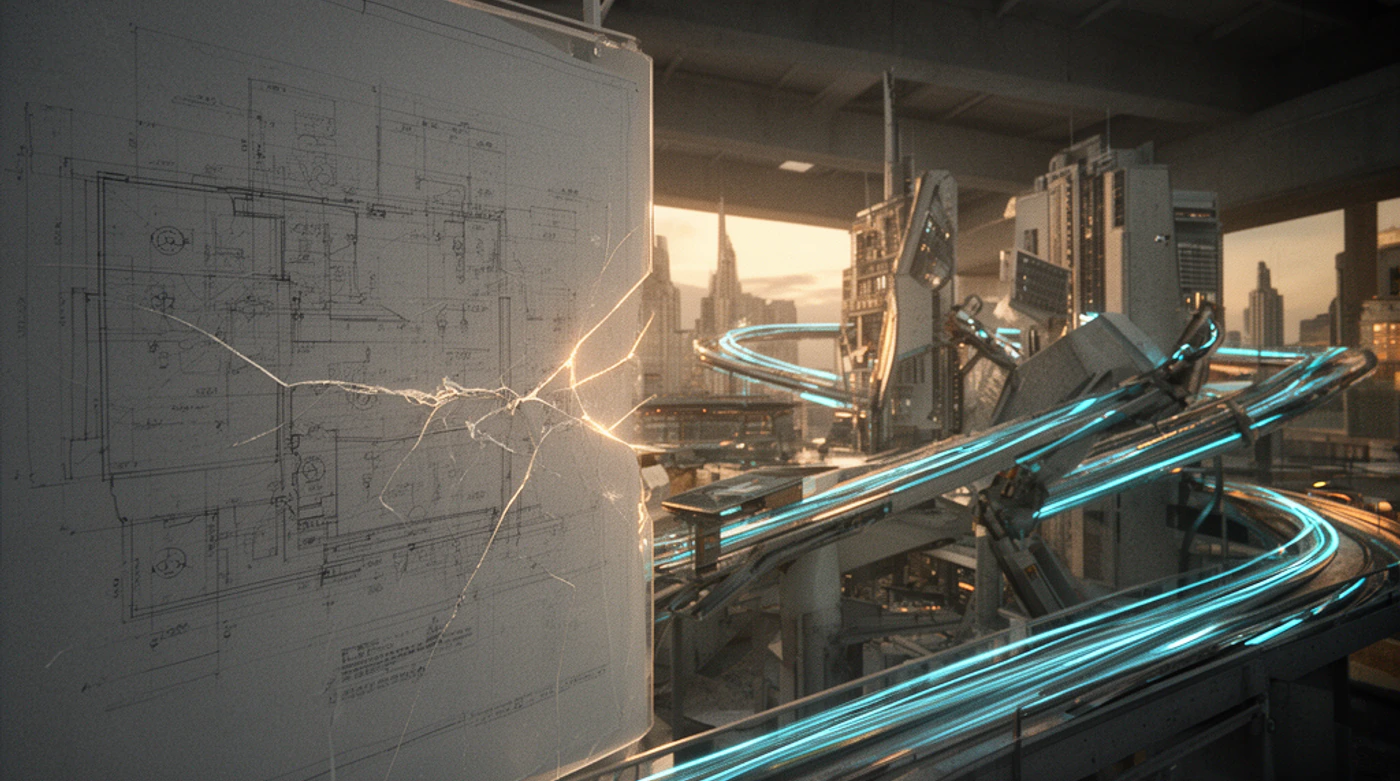
"Designers do not have time to make beautiful mockups anymore."
That sentence sounds like decline, but it misdiagnoses the problem.
For years, mockups were the center of product design because they matched the product reality teams were building: mostly deterministic interfaces, mostly stable flows, mostly predictable states. If you nailed the screen, you were close to nailing the experience. Pixel quality, information hierarchy, and interaction polish were high-leverage work.
That world is fading.
Modern products are not static experiences rendered from fixed logic. They are runtime systems. They adapt by user segment, account state, policy constraints, feature flags, model output, and operational conditions. Two users can touch the same feature and effectively use different products. The interface is no longer one thing.
So teams keep using yesterday's primary artifact for a different class of system, then wonder why handoffs degrade, why implementation diverges, why QA discovers "unexpected" behavior late, and why shipped experience drifts from design intent.
The issue is not that teams suddenly became sloppy. The issue is artifact mismatch.
In this post, I will argue that mockups are being demoted from primary truth source to one layer in a broader behavior design stack. If you keep treating static screens as the center of truth in dynamic systems, you get clean visuals and unstable products.
Thesis: Mockups are ending as the dominant design artifact because modern software behavior is defined by system dynamics, not static screens.
Why now: AI-mediated interactions, runtime configuration, and continuous deployment have made product behavior non-static by default.
Who should care: Designers, frontend engineers, product managers, and leaders deciding how design and engineering should collaborate.
Bottom line: The winning teams design behavior first and visuals second, then keep both linked through shared executable artifacts.
The sentence everyone repeats is true for the wrong reason
When people say there is "no time" for beautiful mockups, they are describing an output symptom, not the root cause.
Teams are not skipping visual refinement only because deadlines are tight. They are redirecting effort toward problems mockups cannot solve by themselves: state logic, edge behavior, confidence signaling, fallback paths, and trust boundaries in AI-assisted flows.
A polished frame can still be high quality and strategically irrelevant if the runtime behavior behind it is incoherent.
Speed pressure exposes the mismatch. It does not create it.
This distinction matters because it changes what to fix. If you believe the problem is time, you hire for faster mockup production. If you believe the problem is artifact fit, you redesign the workflow and truth model for the whole product lifecycle.
Why mockups worked so well in the previous era
Mockups became dominant for good reasons. They compressed intent into a shareable artifact that product, design, engineering, and stakeholders could discuss quickly.
They worked especially well when three assumptions held.
| Assumption | Legacy software reality | Why mockups worked |
|---|---|---|
| Behavior stability | Flows changed slowly and predictably | One static flow captured most real usage |
| State simplicity | Fewer state combinations and policy branches | Edge cases were relatively bounded |
| Interface scarcity | Creating each interface variation was expensive | A "golden screen" represented meaningful production cost |
Under those conditions, mockups were not just visual artifacts. They were close enough to behavioral truth to coordinate execution.
The assumptions are now failing in parallel.
The assumptions collapsed
1) State complexity expanded
A modern flow often depends on entitlements, risk level, plan tier, geo constraints, trust score, prior actions, experimentation cohort, and model confidence. A single entry point can lead to many valid behavioral paths.
One screen cannot represent that state topology.
2) Runtime configuration moved decisions into production
Feature flags, policy engines, progressive rollouts, and model switches mean major behavior decisions are made after deployment. Design truth cannot live only in pre-build visuals when behavior mutates at runtime.
3) AI introduced probabilistic interaction surfaces
LLM-mediated features do not produce one deterministic response map. They produce bounded distributions influenced by prompt design, context retrieval, policy filters, and user input variability.
Design intent must include response behavior, guardrails, and recovery patterns, not only layout.
4) Personalization made "the" interface a fiction
The product increasingly adapts by user maturity, historical behavior, or current objective. This is useful, but it means there is no single canonical screen that all users experience.
Mockups can still represent moments. They cannot represent the whole behavior system by themselves.
The cost of staying screen-first in a behavior-first world
Teams that keep static screens as primary truth source usually hit the same failure sequence.
First, design and engineering agree on the happy path. Next, implementation injects runtime constraints that were absent in the visual artifact. Then QA discovers edge behavior that feels "off-brand" because no artifact encoded the intended fallback logic. Finally, teams patch inconsistencies reactively, and the system accumulates behavior debt.
You can see this in AI assistant onboarding flows.
A beautiful onboarding mock might show a clean confidence message and one primary next action. In production, confidence can be low, policy can block recommended actions, or retrieval can return partial context. Without behavior rules designed upfront, each edge state gets solved ad hoc in code. The visual system remains coherent while the behavioral system fragments.
A pixel-perfect happy path with undefined fallback behavior is not a finished design. It is an unfinished system.
What replaces mockups as primary truth
Mockups do not disappear. They move to the right layer.
The practical replacement is a behavior-first artifact stack where each layer answers a different question.
| Artifact | Core question | Owner pattern | Output form |
|---|---|---|---|
| State and policy map | "What conditions change behavior?" | Design + engineering | State matrix, policy table, transition model |
| Interaction contract | "How should the system respond under variance?" | Product + design + ML/app engineering | Response taxonomy, fallback rules, escalation triggers |
| Component behavior spec | "How do UI primitives behave across states?" | Design systems + frontend | Tokenized components with state props and constraints |
| Visual composition | "How should this feel and read at glance?" | Design | Mockups, motion studies, narrative flows |
The old model made visual composition the source and derived behavior later. The new model aligns behavior and visuals as co-equal outputs from shared system intent.
A concrete operating pattern that works
If your team is transitioning, use this order for new feature work.
- Define decision stakes and failure boundaries before drawing final screens.
- Build a small state map covering primary states, degraded states, and blocked states.
- Specify interaction contracts for each state transition, including fallback and escalation.
- Produce visual artifacts that represent key moments from that behavior contract.
- Validate implementation against behavior and visual intent in the same review loop.
This is still design. It is just design at the resolution modern systems require.
Why behavior debt compounds faster than visual debt
Most teams have an intuitive sense of visual debt. They know what an inconsistent spacing system looks like, or what off-brand typography feels like. Visual debt is visible, so it is politically legible.
Behavior debt is less obvious at first and more expensive over time.
Behavior debt appears when the system repeatedly encounters conditions that were never explicitly designed as user experience. Low-confidence model outputs, partial permissions, stale data, outage fallback, asynchronous timing drift, contradictory policy signals, and recovery moments after failure all become ad hoc implementation choices. Each local patch can look reasonable. The aggregate becomes unpredictable.
The cost profile is nonlinear because behavior debt multiplies across surfaces. A weak fallback pattern in one flow is annoying. The same weak fallback pattern replicated across search, onboarding, permissions, and assistant interactions becomes trust erosion at product level. Users cannot build stable mental models when similar states behave differently in adjacent contexts.
This is where teams get trapped. They keep funding visual refresh work because visual problems are easy to point at in screenshots, while behavior coherence failures hide inside runbooks, support tickets, and retention drift. The organization sees beautiful artifacts and rising operational noise at the same time, then treats them as unrelated.
They are related. The artifact model is directing investment toward visible polish and away from systemic behavior quality.
Review architecture: one meeting for beauty, one meeting for behavior
A practical transition pattern is to split design review into two explicit checkpoints instead of one blended conversation that defaults to visual critique.
The first checkpoint is visual narrative review. This is where teams evaluate hierarchy, density, pacing, language, and emotional tone. It protects craft and keeps the interface legible and distinctive.
The second checkpoint is behavior coherence review. This is where teams evaluate state transitions, fallback rules, confidence communication, policy conflicts, and degraded-mode interactions under realistic operating conditions.
When teams combine both into one meeting, behavior topics are usually rushed because visual feedback is easier to discuss quickly. Separating checkpoints protects both forms of quality and makes ownership boundaries explicit.
It also improves engineering estimation quality. Engineers can scope behavior complexity early instead of reverse-engineering hidden requirements from polished screens. Product can prioritize based on risk and trust implications rather than presentation confidence. QA can build scenario coverage from intentional behavior definitions instead of inferring expected outcomes after implementation.
This split does not require more bureaucracy. It requires clearer purpose for existing review time.
Toolchain consequences most teams underestimate
Shifting away from mockup primacy is not only a writing or meeting habit change. It has toolchain implications that many teams ignore until friction appears.
Component libraries need to encode behavior semantics, not only visual variants. Design tokens need to carry state and interaction constraints where possible. Prototyping environments need to support conditional logic and degraded-state representation. Documentation systems need first-class space for transition contracts and failure-handling decisions.
If toolchain stays screen-centric while process language becomes behavior-centric, teams create a policy-implementation mismatch. People agree on behavior-first in principle, then execute with tools optimized for static composition, and drift returns.
Mature teams address this deliberately. They treat behavior specifications as versioned artifacts. They tie component updates to behavior contract changes. They include telemetry intent in design handoff. They expect cross-functional review comments on runtime behavior before release, not only visual fidelity after implementation.
In short, they make behavior design executable.
Once this is in place, mockups become more useful, not less. Instead of carrying impossible truth burden, they become high-signal communication artifacts anchored to system behavior that has already been defined. Visual craft gets better because it is no longer compensating for missing interaction logic.
The migration playbook for teams with legacy process debt
Most organizations cannot replace their artifact model overnight, and they should not try. Abrupt process replacement usually creates defensive behavior and quality regression.
A better approach is staged migration.
In phase one, keep existing mockup workflow but require a lightweight behavior appendix for any feature touching policy, permissions, confidence signals, or fallback logic. The appendix should be short enough to sustain adoption, but concrete enough to remove ambiguity.
In phase two, promote behavior appendices into first-class artifacts with explicit owners and release checks. This is where teams begin tracking behavior debt intentionally and can correlate it with support burden and rework.
In phase three, align design systems, engineering standards, and release governance around the new truth hierarchy. At this stage, screen artifacts remain essential but are explicitly downstream of behavior contracts for dynamic features.
This migration path preserves momentum while changing foundation.
How to know the shift is actually working
Teams often ask for one clear indicator that they have moved beyond rhetoric. The best indicator is where ambiguity is discovered.
If ambiguity is still discovered in implementation or QA, the old model is still dominant.
If ambiguity is discovered during behavior framing and review, the new model is taking hold.
You can also look for secondary signals: fewer launch-week debates over fallback behavior, fewer contradictory states across adjacent journeys, cleaner support narratives for edge cases, and faster resolution cycles when runtime conditions change.
These signals matter because they reveal whether the system is learning as a system. Visual quality and behavioral quality should rise together. If one rises while the other declines, the artifact stack is still misaligned.
The point is not to eliminate iteration. The point is to move high-cost iteration earlier, where it is cheaper and less damaging to user trust.
The hidden governance layer: release criteria as design policy
One of the most overlooked levers in this transition is release governance.
Teams can adopt behavior-first language, build better artifacts, and still regress if release criteria remain screen-centric. If the final question before launch is still "does it match the mock," organizations will repeatedly ship polished visuals with unresolved behavioral variance.
Design leadership should help define behavior-aware release criteria. These criteria should include degraded-path handling quality, confidence communication consistency for AI-mediated flows, policy-conflict behavior clarity, and explicit recovery pathways for common failure classes. When these checks are built into release policy, design truth remains aligned through execution pressure.
This also creates better accountability conversations. Instead of arguing over subjective impressions of quality, teams evaluate whether agreed behavior conditions are satisfied. That produces clearer go/no-go decisions and fewer post-launch surprises.
The long-term effect is cultural. People start treating behavior coherence as non-negotiable product quality, not as optional polish after core scope ships.
What to stop doing immediately
If your team wants fast improvement, stop using mockup approval as a proxy for implementation readiness on behavior-heavy features.
A signed-off screen set can still hide unresolved state transitions, ambiguous fallback rules, and untested trust signals. Treating it as readiness creates false confidence and shifts risk into launch week.
Also stop framing behavior issues discovered late as engineering misses by default. In many cases, those issues are upstream artifact misses that were never represented clearly enough for implementation to follow with confidence.
And stop allowing high-risk flows to pass review without explicit degraded-state narratives. If the happy path is the only designed experience, the product is not designed for reality.
These changes are simple, but they remove recurring friction quickly.
The broader point is straightforward: every adaptive product eventually reveals the limits of screen-first truth models. Teams that adjust early get cleaner execution and more resilient trust. Teams that delay keep paying behavior debt while believing they are optimizing design throughput.
A final operating note: this transition is not about abandoning the language of design that teams already understand. It is about extending that language so it can describe runtime reality honestly. If your process can explain only what the interface looks like and not what it does under stress, the process is incomplete for modern software.
Teams that make this extension well do not lose speed. They lose avoidable rework.
Common objections
"If mockups are secondary now, visual craft will collapse"
Only if teams interpret behavior-first as anti-visual, which is a category mistake. Visual quality still drives trust, comprehension, and perceived competence. The change is sequencing and truth hierarchy, not abandonment of craft.
"This is just engineering trying to absorb design"
Bad implementations of the shift can look that way. Good implementations increase design influence by moving design upstream into constraint definition and behavior strategy, instead of limiting design to post-hoc decoration.
"We can just make more mockups for edge cases"
At scale, this becomes expensive and still incomplete. The number of behavioral combinations grows faster than static artifact production capacity. You need generative rules, not only additional frames.
"Our product is simple, so this does not apply"
Many products appear simple at surface and become complex at operation boundaries: permissions, billing, compliance, retries, outages, personalization, and model uncertainty. Simplicity on the screen often depends on complexity beneath it.
Leadership consequence: what you reward changes what gets designed
If organizations keep rewarding screen velocity as the dominant design KPI, teams will optimize for visual throughput even when system behavior quality is the real bottleneck.
If leaders instead reward behavior coherence, reliability under variance, and trust-preserving fallback design, teams will invest in artifacts that match real product risk.
This shift also changes team boundaries.
Design systems teams become behavior systems teams.
Frontend engineers become active co-authors of interaction semantics.
Product managers need to reason about condition logic, not only feature narratives.
Design leaders need to evaluate design quality across perception, behavior, and operational integrity.
What to change this quarter
If you want this transition to be real instead of rhetorical, set explicit artifact policy.
- Require a state-and-policy artifact before final design signoff on behavior-heavy features.
- Require fallback and degraded-state interaction contracts for any AI-mediated experience.
- Keep mockups mandatory for visual clarity and narrative flow, but mark them non-authoritative for behavior logic.
- Review implemented features against behavior contract and visual intent in the same acceptance gate.
- Track behavior debt the same way you track design debt and technical debt.
None of this slows serious teams down. It reduces rework disguised as speed.
Mockups are not dead. They were demoted.
Mockups still matter. They remain powerful for communicating intention, hierarchy, and emotional tone. But they can no longer carry the full burden of design truth in adaptive systems.
The center of gravity moved.
Design now lives across state logic, interaction policy, component behavior, and visual composition as one connected system.
Teams that accept this build products that feel coherent even under stress.
Teams that ignore it keep shipping beautiful artifacts over unstable behavior.
The end of mockups is not the end of design.
It is the end of pretending the screen is the system.