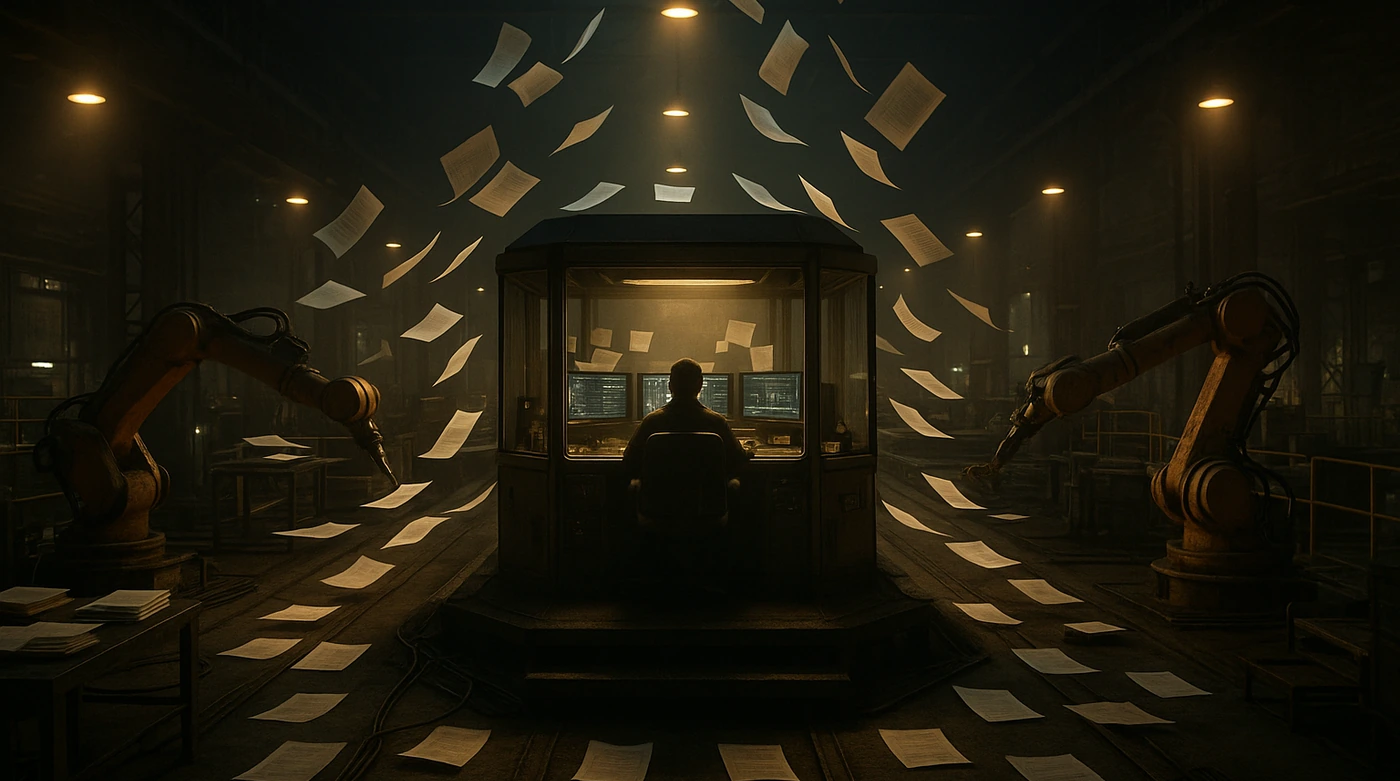
The easiest way to misunderstand modern LLM systems is to think the model is the product. I still see teams build as if the model is a really smart text box. Ask question, get answer, ship interface. It works for demos. It does not hold up when you need an AI system to coordinate real work.
The 2026 shift is this: LLMs are moving from summarizers to controllers. A controller does not just generate language. It plans, calls tools, reads and writes structured state, checks intermediate results, and only then returns output. The language model is still central, but now it is inside a loop with memory, actions, and guardrails. That one design decision changes everything.
Where It Becomes Real: File-Based Workflows
Most of the useful work in serious environments is file-native before it is chat-native. Engineering teams work from repos, specs, logs, and incident documents. Operations teams work from tickets, runbooks, spreadsheets, and reports. Legal teams work from contracts, revisions, and policy artifacts. Industrial teams work from CAD exports, telemetry files, inspection images, and structured records.
When you build around files, you get four things that chat-only systems usually miss.
- State that persists beyond one conversation.
- Reproducibility of how outputs were created.
- Better collaboration between human and model.
- Clearer audit trails.
That is why file workflows matter. They are not old-school. They are the backbone of accountable automation.
The Architecture Pattern I Trust
The pattern I keep coming back to is simple and durable. The model classifies intent. A planner breaks work into executable steps. A tool layer reads and writes files, queries systems, and runs constrained operations. A verifier checks claims and schema integrity. A synthesizer produces the final output and logs the path.
If you want this to survive contact with production, keep the control loop explicit.
- Keep planning separate from execution.
- Keep execution separate from verification.
- Keep every important write action permissioned.
- Keep all intermediate state inspectable.
I have watched this structure outperform "one giant prompt" approaches over and over. Not because the model is better, but because the system is easier to reason about when it fails.
Why 2026 Made This Easier
Tooling finally caught up to the architecture. By 2025 and 2026, the major model platforms standardized tool use patterns enough that teams can build controller-style systems without glue code chaos. The Model Context Protocol matured quickly through 2025 revisions, and tool ecosystems started looking more like interoperable infrastructure than custom integrations. At the same time, API patterns shifted toward agent-oriented primitives: built-in file retrieval, code execution, web retrieval, remote MCP servers, and stronger traceability hooks. That matters because controller systems are not one feature. They are orchestration.
You cannot reliably orchestrate if your tool surface is brittle.
The Bridge to Physical AI Is Not a Stretch
This is where people still treat two conversations as unrelated. They discuss enterprise LLM workflows on one side. They discuss robotics and physical AI on the other. In practice, both are converging on the same control pattern. A robot loop is not fundamentally different from a strong file-controller loop.
- Perception inputs arrive from sensors instead of document stores.
- Plans are generated under constraints.
- Actions are executed through tool interfaces or actuators.
- Feedback is validated against goals and safety policies.
- State is updated and the loop repeats.
Same shape. Different substrate. That is why the robotics resurgence in 2025 mattered. Google DeepMind introduced Gemini Robotics and Gemini Robotics-ER in March 2025 as vision-language-action systems built for embodied tasks. NVIDIA pushed hard on physical AI with Isaac GR00T releases through 2025, plus large synthetic data and simulation workflows to reduce dependence on manual demonstration data.
Those are not side stories. They are evidence that leading labs are moving past pure text scaling as the only frontier worth chasing.
Why This Matters for Industrial and Automation Work
If your world includes industrial operations, infrastructure, or regulated environments, controller-first design is not optional. A summarizer can draft notes about a maintenance run. A controller can ingest inspection data, compare it to a threshold policy, generate a repair work order, update a tracking file, and flag exceptions for human approval. That is real leverage. And if your stack is local-first, this becomes even more practical in 2026 because smaller models and better routing let you keep large parts of the control loop on-prem while selectively escalating harder reasoning steps.
The result is usually better privacy, lower latency, and more predictable cost.
How I Approach Implementation
When I set these systems up, I start from operational risk, not from model excitement. First, define what actions are allowed, what needs approval, and what must always be human-reviewed. Second, turn workflows into explicit file-backed states. If you cannot replay the workflow from saved state, debugging will hurt later. Third, define output contracts and failure semantics. "I do not know" and "I need clarification" should be first-class states.
Fourth, instrument everything. Every plan, tool call, and write action should be traceable. Fifth, only then optimize model choices and latency. Teams often reverse this order and pay for it with hidden reliability debt.
The Mistake to Avoid
Do not confuse fluent language with reliable control. A model that writes beautiful prose can still be a weak controller. Control quality depends on action selection, permission discipline, verification strength, and state management. If those are weak, the system is weak even if every response sounds brilliant.
My Opinion on the Next Two Years
I think this is where the biggest practical gains will come from. Not from arguing about who has the smartest general model this quarter. From building controller-grade systems that can run useful loops over real artifacts, under real constraints, with real accountability. And I think physical AI will accelerate this shift. As robotics and embodied systems push harder into production, software-side AI teams will inherit a more mature discipline around control, simulation, safety, and observability.
That is good for everyone. The frontier is not just better text generation anymore. The frontier is controlled action.